

Introduction
Feathering a concrete patch means shaping the edge with undercuts and a micro-overlay so the repair blends with the surrounding slab. It’s about creating a gradual transition, not a hard line or a loaded patch. You’ll want a clean bond, good surface prep, and a plan for the edge quality as you go.
This intro walks through how to prep for a strong bond, how to check for sound concrete, and what signs suggest trouble like cracks or scaling. We’ll touch on edge preparation, practical undercut ideas, and how to assess the existing concrete before you start. Practical, hands-on steps and quick checks help you avoid common failure modes and keep the patch durable.
Key takeaways
- Assess concrete soundness before patching; document symptoms, causes, and areas.
- Use abrasive blasting for proper bonding only where allowed; follow safety rules.
- Identify six symptoms of unsound concrete and six causes to guide repairs.
- How to detect unsound concrete includes visual, moisture, and core sampling checks.
- Feather patches with careful undercutting; maintain edge stability to prevent delamination.
- Budgeting and QA require documenting steps, safety compliance, and maintenance after repair.
Table of Contents
- Introduction
- Key takeaways
- Practical Next Steps and Trusted Sources
- Sound Vs. Unsound Concrete — Symptoms and Root Causes
- How to Detect and Document Unsound Concrete
- Surface Preparation — Blasting and Other Methods for Proper Bonding
- Removing Unsound Concrete Safely and Effectively
- How to Feather a Concrete Patch Without a Weak Edge — Step-by-Step Procedure
- Tools, Materials, Specs, and Safety
- Budgeting, Common Mistakes, QA, and Maintenance After Repair
- Conclusion
- FAQ
Practical Next Steps and Trusted Sources
DIY-appropriate scenarios include small, non-structural patches and cosmetic fixes where feathering edges and creating a bondable surface is feasible. Look for moisture present and edge integrity before proceeding. If there are doubts about substrates or potential service loads, pause and verify with reliable references.
Decide when to hire a concrete repair specialist by noting deep cracks, hollow spots, persistent moisture, or delamination that could compromise performance. Gather tips from trade associations, manufacturer instructions, and local distributors. Use a simple checklist to distinguish Go DIY from Call a pro, and document your findings with a quick scoring on edge readiness and bond potential.
When DIY is appropriate
DIY concrete patching can be a cost-effective solution when done right. Here’s when you should consider tackling it yourself:
Size matters: Stick to small, non-structural patches. If the damage spans more than 2-3 feet or affects structural integrity, call a pro.
Cosmetic fixes only: DIY is great for fixing minor cracks and surface issues that don’t compromise your concrete’s strength.
Feathering and bonding: If you can feather the edges of your patch and create a clean, bondable surface without exposing it to heavy service loads or weather damage, go ahead. But remember, feathering techniques from earlier in this guide will help ensure a strong bond.
When to contact a professional
Knowing when to call in the experts can save you time, money, and headaches. Here are some red flags:
Deep cracks or structural damage: If cracks are deep, wide, or run through multiple slabs, it’s time to call a pro. They might need to assess if there’s underlying structural issues.
Moisture intrusion: Recurring moisture problems could indicate bigger issues like leaks or poor drainage. A professional can help diagnose and fix these problems at the source.
Unknown contamination: If you’re unsure about what caused the damage, it’s best to have a pro take a look. They can test for contaminants and recommend appropriate repairs.
Resources and how to get expert advice
Don’t hesitate to reach out to experts when you need help. Here are some resources:
Trade associations: The International Concrete Repair Institute (ICRI) offers guidelines and can direct you to local professionals.
Manufacturer tech lines: Contact the manufacturer of your chosen patch product. They can provide technical support, troubleshoot issues, and ensure compatibility with other materials.
Document before contacting: Before reaching out, document the problem by taking clear photos from different angles. Note any relevant details like surface prep state, patch product used, and curing conditions. This helps experts understand your situation better and provide more accurate advice.
Sound Vs. Unsound Concrete — Symptoms and Root Causes
Sound concrete can be assessed by basic criteria such as uniform surface, no delamination, and solid edge integrity. Refer to standard test methods on label or data sheet when available. Use this baseline to compare against observed conditions.
Common signs of unsound concrete include cracks, spalling, scaling, delamination, voids, and moisture-related staining. Each symptom points to categories like moisture intrusion, poor surface prep, chemical attack, improper cure, or substrate movement. Link each symptom to a practical cause and simple remedy you can verify on site.
What “sound concrete” looks like
Sound concrete is strong, durable, and well-bonding. Here’s what it looks and feels like:
Compressive strength: It’s hard to measure with your hands, but you can tell by the way it takes a beating without crumbling. ASTM C39 is the standard test for this.
No delamination or microcracking: Tap it gently with a hammer. If it sounds solid, that’s good. No hollow spots means no hidden cracks or layers peeling off.
Surface integrity: It should be even, without any obvious pits, holes, or flaking. A quick pass with a straight edge will show you any dips or high spots.
Common symptoms of unsound concrete
Unsound concrete shows signs of distress. Here are the top ones:
Cracks: Hairline or wide, they weaken bond and invite moisture. Too many cracks mean it’s time for a professional.
Spalling & scaling: Flaking or peeling surface means the concrete is delaminating. It can’t hold together under stress anymore.
Voids & dusting: Hollow spots and powdery residue indicate weak, crumbly concrete. This won’t bond well with a patch.
Moisture-related staining: Dark patches or efflorescence (white deposits) show moisture is getting in where it shouldn’t be. That’s bad news for your patch job.
Typical causes of unsoundness
Unsound concrete has underlying issues. Here are the main culprits:
Moisture intrusion: Water weakens concrete over time. It can cause cracks, delamination, and scaling. Keep water out to prevent this.
Incorrect preparation/adhesion surfaces: If the surface wasn’t clean or properly prepared, your patch won’t stick. Poor adhesion leads to early failure.
Carbonation & chemical attack: These can corrode rebar and damage the concrete matrix. ASTM C876 tests for carbonation depth.
Improper mix or cure: Too much water, not enough aggregate, or poor curing all lead to weak concrete. Follow mix designs and cure properly to avoid this.
How to Detect and Document Unsound Concrete
Start with surface-level checks and then move to simple on-site tests to decide if more advanced analysis is needed. Use a consistent visual approach to track changes over time. Note dates and locations for progress records.
Document symptoms such as widespread cracking or hollow sounds with clear photos and maps. Perform rudimentary tests like tapping for voids and checking moisture on the surface. When results are inconclusive, outline criteria for escalation to NDT or lab analysis.
Step-by-Step Process
The following steps guide you through detecting and documenting unsound concrete, ensuring a thorough inspection.
- Preparation: Gather safety gear (hard hat, safety glasses), tools (hammer, chisel, probe, tape measure), and documentation materials (camera, notebook).
- Safety checks: Ensure the area is safe. Barricade if needed. Wear appropriate PPE.
- Visual inspection: Check for cracks, scaling, delamination, spalling, blisters, and dusting. Document with photos and notes.
- Sound tests: Tap the concrete with a hammer. Listen for dull or hollow sounds indicating voids. Mark suspicious areas.
- Probe test: Use a chisel and hammer to probe marked areas. If material comes out easily, it’s unsound. Document findings.
- Crack width measurement: Measure crack widths using a crack gauge. Record measurements.
- Moisture check: Perform a simple moisture test using a surface moisture meter or calcium chloride test. Note results.
- Final checks: Review findings, photos, and notes. Clean up the area.
Visual and Tactile Inspection Checklist
Use this checklist during your initial visual inspection to ensure nothing is missed.
- Cracking: Look for cracks of any size. Note their width, length, and direction.
- Scaling: Check for flaking or peeling concrete. This could indicate weak aggregate-paste bond.
- Delamination: Tap the surface with a hammer. Listen for a hollow sound indicating delaminated layers.
- Spalling: Look for chipped or broken edges. This can indicate severe deterioration.
- Blisters: Check for raised, blister-like areas. These often contain trapped air or water vapor.
- Dusting: Wipe the surface with a damp cloth. If it leaves a white residue, there may be excessive dusting due to poor curing or inadequate admixtures.
- Laitance: Check for a weak, porous layer on the surface. This can indicate improper finishing techniques.
- Contaminants: Look for stains, discoloration, or other signs of contamination that could affect concrete performance.
- Map locations: Use a simple sketch or app to mark the location of each symptom. This helps track repairs later.
- Date and conditions: Record the date and current weather/environmental conditions for future reference.
Quick rule: Always document findings with photos, notes, and sketches to ensure accurate record-keeping.
Simple Field Tests and When to Escalate
Perform these simple field tests to gather more information about the concrete’s condition. Escalate to professional testing when necessary.
Sound tests: Tapping with a hammer is quick and easy, but it only provides qualitative data. Use this method to identify suspicious areas for further testing.
Pull-off tests: These provide quantitative data about the concrete’s strength. However, they destroy the tested area and may not be practical for large inspections. Consider using them when targeted strength information is needed.
Moisture checks: Moisture content affects concrete’s performance. Use simple moisture tests to identify areas with excessive or insufficient moisture. Escalate to professional testing if moisture-related issues are suspected but not confirmed.
When to escalate: If you find widespread symptoms, inconsistent results, or critical-load concerns (like structural elements), consider commissioning professional NDT (ultrasonic pulse velocity, rebound hammer readings, ground-penetrating radar) or lab tests (compressive strength, petrographic analysis). Always consult with a professional if you’re unsure about the severity of the issues.
Surface Preparation — Blasting and Other Methods for Proper Bonding
Surface profile and cleanliness drive bond strength, especially for feathered edges. A rough, clean surface gives the patch material something to grab onto. Assess the substrate and plan the prep accordingly.
Choose mechanical blasting, scarification, or brush cleaning based on condition and coating. Remove dust, grease, curing compounds, and laitance, then verify dryness before patching. Use quick checks like a damp wipe test to confirm readiness.
The role of abrasive blasting in concrete removal and patch profiling
Abrasive blasting is a powerful tool for both removing unsound concrete and preparing the surface for overlays or patches. It works by propelling tiny, hard particles at high speeds to strike and remove material.
Blasting is preferred when you need to remove significant amounts of concrete. It’s also great for creating a uniform profile that promotes strong bonding. The blasting process exposes fresh, clean surfaces with microscopic peaks and valleys – perfect for mechanical interlocking.
However, it’s not always the best choice. Blasting can be aggressive, potentially damaging sound concrete if not done right. Always use proper equipment, protective gear, and technique to avoid this.
Alternative preparation methods and when to use them
While abrasive blasting is a go-to method, other techniques can be useful depending on the situation. Here’s a quick rundown:
Shotblasting is similar to abrasive blasting but uses steel shot instead of grit. It’s gentler and better for removing coatings or preparing surfaces with existing damage.
Diamond grinding uses diamond-impregnated tools to level and smooth surfaces. It’s ideal for large, flat areas like slabs or bridge decks, but it won’t create the micro-peaks needed for feathered edges.
Scabbling uses a hammer-like tool to chip away at concrete. It’s good for small repairs and tight spaces, but it can be labor-intensive and may not provide a consistent profile.
Hand or rotary tools are useful for minor touch-ups or removing small areas of unsound concrete. They’re versatile but require skill to avoid damaging sound concrete.
Visual checkpoints for acceptable surface profile
Before applying your patch, use this checklist to ensure the surface is ready. Perform these checks after any blasting or other prep methods.
- Uniform texture: The surface should look consistent across the entire repair area. Inconsistencies could indicate missed spots or damage.
- No residual laitance: Laitance is a weak, dusty layer that forms on concrete surfaces. If present, remove it with a stiff brush or wire tool.
- Clean exposed aggregate (where required): For micro-overlays, you want clean aggregate to ensure good bonding. Use a wire brush or compressed air to remove any debris.
- No visible cracks or damage: Check for new cracks or signs of damage that might have occurred during prep work.
- Moisture-free surface: Ensure the surface is dry before patching. Moisture can weaken the bond and cause delamination.
- No visible contaminants: Remove any dust, grease, sealants, curing compounds, or efflorescence that could interfere with bonding.
- Consistent color: The prepared surface should match the surrounding concrete in color. Significant discoloration might indicate contamination or damage.
- No shiny spots: Shiny areas suggest residual laitance or other contaminants that need to be removed.
Quick rule: If you’re unsure about any aspect, perform a simple pull-off test using duct tape. If it sticks well and pulls off cleanly, the surface is likely ready for patching.
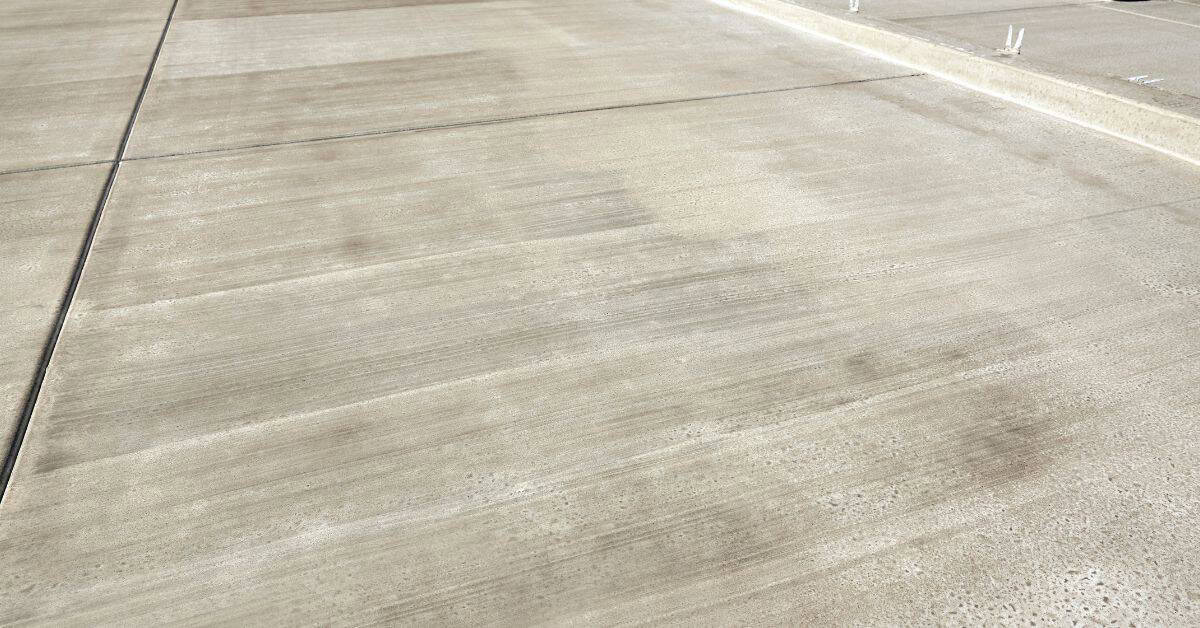
Removing Unsound Concrete Safely and Effectively
Define unsound concrete by visible signs of damage and deterioration in the patch area to justify removal. Map rebar locations and note coatings to avoid surprises. Establish avoidance zones to protect sound margins.
Choose removal methods that match the patch size and substrate, prioritizing controlled mechanical approaches over aggressive blasting. Contain debris and control dust, then preserve edge integrity for a solid bond later.
Removal techniques and tool selection
The right tools make all the difference. Match them to your job.
- Abrasive blasting: Cleans, profiles, and removes weak concrete. Use with care to avoid microcracking. Rental: $50-$100/day.
- Pneumatic chipping hammer: Breaks up concrete around rebar. Depth guide prevents overcutting. Rentals start at $30/day.
- Diamond tools (blades/wheels): Cut through concrete and steel. Ideal for precise, dust-free removal. Prices vary; rentals available.
- Scabblers: Remove thin layers of weak concrete. Useful for small patches. Rentals start at $20/day.
- Hammer-and-chisel: Manual method for tight spaces. Depth guide prevents weak edges. Inexpensive; buy or rent.
Creating controlled edges vs. undercutting
Proper edge control ensures a strong bond for your patch.
Keyed edges: Form them using backer boards or shields to create intentional, safe micro-undercuts. This increases surface area and mechanical bond.
Intentional undercuts must be balanced. Too deep, they become stress risers, weakening the surrounding concrete.
Staggered removal: Remove unsound concrete in layers to prevent weak edges. Start from one side, work across, then fill in any gaps from the other side.
Visual checkpoints during removal
Before patching, ensure all unsound material is gone and the substrate is exposed.
- Exposed rebar: Check for any broken or missing bars. Replace if necessary.
- Concrete surface: Ensure it’s clean, sound, and free of contaminants.
- Rebar coatings/corrosion: Inspect for signs of rust or damage. Remove coatings if needed.
- Edge profile: Verify a consistent, rough edge for optimal bonding.
- Moisture condition: Check for any remaining dampness. Patch only when dry.
- Debris removal: Ensure all loose material is cleared from the patch area.
- Rebar alignment: Confirm bars are straight and aligned with the surrounding concrete.
- Edge-to-edge consistency: Check that the entire patch area meets these standards.
Quick rule: If in doubt, clean and prep again. A solid bond starts with a sound substrate.
How to Feather a Concrete Patch Without a Weak Edge — Step-by-Step Procedure
State the feathering objective as a solid transition with a non-foam edge that resists delamination. Ensure the plan supports undercuts and micro-overlays with a strong feather margin. Prepare to verify bond readiness at the transition.
Prepare the surface by removing loose material, cleaning, dampening, and roughening the surrounding concrete. Select a patch material with good adhesion characteristics for feathering and set up a gradual taper with controlled tooling actions.
Step-by-Step Process
Follow these practical steps to feather a concrete patch without creating a weak edge.
- Prepare the area: Remove loose material, clean thoroughly, and dampen the patch area. Roughen surrounding concrete for better bond. Refer back to Surface Preparation if needed.
- Select compatible patch material: Choose a mix with good adhesive properties suitable for feathering.
- Apply patch material: Spread the mix slightly over the edge. This helps create a smooth transition.
- Feather the edges: Use an angled trowel to create a gradual taper. Make back-and-forth passes to shape a micro-overlap that blends with the substrate.
- Inspect and test: Check feather margins for uniform thickness. Test bond at the transition to ensure strength. If weak spots are found, repeat feathering steps.
Forming undercuts and micro-overlays
Undercuts and micro-overlays help prevent brittle feather edges. Here’s how to form them:
Undercuts: Use a chisel or grinding tool to create partial depth keys in the existing concrete. This increases surface area for better bond.
Micro-overlays: When applying the patch material, extend it slightly over the edge. Use an angled trowel to create a smooth, gradual taper that blends with the substrate.
Undercuts and micro-overlays work together to distribute stress evenly across the repair, preventing delamination at the feather edge.
Mixing, bonding agents, and application technique
Proper mixing and use of bonding agents ensure a strong bond between patch and substrate:
Mix the concrete patch according to manufacturer’s instructions. For feathering, aim for a slightly wetter mix consistency.
Apply a compatible primer or bonding agent to both the existing concrete and the patch material. This enhances adhesion and prevents delamination.
Work quickly but carefully: Avoid creating cold joints. Keep the patch and substrate at similar temperatures, and apply materials in manageable sections.
Finishing, curing, and minimizing visible edges
Proper finishing and curing techniques help minimize visible edges and prevent cracking:
Use a sequence of trowels to smooth the patch surface. Match the texture of the surrounding concrete for a seamless finish.
Cure the patch properly: Cover it with plastic sheeting or damp burlap. Maintain humidity and temperature within recommended ranges to prevent premature shrinkage and cracking. Refer back to Curing Concrete if needed.
Inspect the feather edge for strength: Gently tap it with a hammer. A strong, solid sound indicates a good bond. If it sounds hollow or weak, repeat feathering steps and re-cure.
Tools, Materials, Specs, and Safety
List essential tools for feathering, including trowels, an undercutting tool, grinder, dust extraction, and a mixer. Include a moisture meter and note when more aggressive profiling is appropriate. Keep blasting options in mind for tougher surfaces.
Catalog patching mortars, bonding agents, and compatible aggregates. Reference relevant standards and performance checks, and verify substrate cleanliness and moisture before use. Prioritize safety with PPE and site controls throughout the process.
Tools and materials checklist
Before you start, make sure you have all the necessary tools and materials for a successful patch job.
- Trowels: Margin trowel (1/2″ to 3/4″) and standard trowels (6″ to 12″).
- Undercutting tools: Hammer, chisel set.
- Surface prep tools: Grinder or sander with diamond blades/cups, dust extraction system.
- Mixing options: Power mixer (drill and paddle) or hand mixing tools.
- Moisture meter: To gauge substrate conditions before patching.
- Patching materials: Patching mortars, micro-overlay blends, bonding agents/primers.
- Safety gear: Eye protection, face shield, gloves, and a respirator for dust control.
- Abrasives (for blasting): Silica sand, steel shot, or other compatible media.
Quick rule: Always check your tools and materials before starting. Missing something can lead to poor results or job delays.
Material specs, compatibility, and standards to verify
Choosing the right materials is crucial for a strong, lasting patch.
- Cement type: Use Type I or II Portland cement. Avoid Type III for its rapid strength gain as it can cause cracking.
- Tensile/compressive values: Look for patches with tensile strengths of 300-500 psi and compressive strengths of 4,000-6,000 psi.
- Adhesion criteria: Ensure the patch material adheres well to the substrate. Check the manufacturer’s data on bond strength.
- Slump/flow targets: Aim for a slump of 4″ to 6″ for easy placement and leveling.
- Aggregate size: Match the aggregate size in your patch to that of the existing concrete (usually 3/8″ to 1/2″).
- Backing/underlayment: For micro-overlays, use a compatible underlayment like a latex-modified concrete or a cement-based leveling compound.
- Environmental limits: Follow the manufacturer’s guidelines for temperature (50°F to 90°F), humidity (<75%), and surface moisture (dry).
Safety and environmental precautions
Protect yourself, your surroundings, and the environment by following these safety measures.
Personal Protective Equipment (PPE): Wear appropriate eye/face protection, gloves, and a respirator to protect against dust and chemicals.
Dust control: Use a dust extraction system when grinding or blasting. Keep the area well-ventilated during and after work.
Blasting media containment: Contain blasting media within the work area to prevent environmental contamination. Dispose of used media responsibly, following local regulations.
Waste disposal: Properly dispose of chemicals and waste materials according to local regulations to protect the environment.
Budgeting, Common Mistakes, QA, and Maintenance After Repair
Outline a practical budget and timeline that covers materials, tools, and crew time, plus a contingency for rework. Keep expectations aligned with cure times that affect edge strength. Plan around weather and site conditions.
Identify high-risk factors such as poor surface prep or skipped feathering that lead to weak edges. Use a simple QA checklist during prep and repair to spot issues early, and establish a maintenance plan for future patches with routine inspections.
Budget and project planning guidance
Repairing concrete patches can be a significant investment. Here’s what to consider when budgeting.
Diagnostics: Identify the root cause of the damage before planning repairs. This may involve hiring professionals for assessments, which add to costs but ensure accurate solutions.
Labor and equipment: Hiring a professional crew or renting tools can be pricey. Consider your skills and available time when deciding whether to DIY or hire help.
Materials: Costs vary based on patch mix, bonding agents, primers, and other supplies needed. Always factor in a contingency for rework due to unexpected issues.
Common mistakes to avoid
Even with the best intentions, DIY repairs can go awry. Here are some frequent errors and how to prevent them:
- Insufficient prep: Skimping on surface cleaning and preparation leads to weak bonds.
- Over-feathering: Excessive feathering can weaken the patch edge, making it prone to cracking.
- Wrong material choice: Using incompatible materials or incorrect mix ratios compromises repair strength.
- Poor curing: Inadequate moisture and temperature control during curing causes weak patches.
Regularly review these common mistakes to ensure you’re not making them in your repairs.
Post-repair QA and maintenance checklist
After completing a repair, it’s crucial to inspect and maintain the patch to ensure its longevity. Use this checklist:
- Pull test: Perform a pull test on the repaired area after initial curing to confirm bond strength.
- Visual edge checks: Inspect edges for signs of cracking or delamination every few days during the first month.
- Monitor for new cracking: Keep an eye out for new cracks forming near the repair, which may indicate underlying issues.
- Moisture and temperature control: Maintain consistent moisture levels and protect from extreme temperatures to prevent curing issues.
- Periodic bond checks: Re-test bond strength periodically to ensure it hasn’t weakened over time.
- Crack monitoring: Regularly inspect for new cracks, which could indicate further damage or settling.
- Inspection rubric: Develop a simple, repeatable inspection routine for future patches to catch issues early.
Quick rule: Inspect and maintain your repairs regularly to extend their lifespan and prevent costly rework.
Conclusion
Sticking to a solid method protects safety, keeps the patch durable, and makes the surface look right. The right approach means not rushing the prep, testing the bond, and feathering you patch so it won’t create a high spot or a weak edge.
Check takes one pass. in plain terms: test the area for soundness, document the findings, choose the correct surface prep, remove any unsound concrete, feather the edge with a tight undercut, apply the micro-overlay as directed, cure properly, and then verify the patch with QA checks before normal use. Do the work in small steps, and always follow the material specs and safety rules.
Common mistakes to avoid are skimping on surface prep, trying to patch over soft or hollow spots, and rushing curing. Don’t skip blasting or other bonding methods if they’re needed, and never mix patches in a way that leaves a weak edge. Always wear eye protection and gloves, keep dust down, and test a small test patch first to confirm bonding and appearance.
If the concrete shows widespread deterioration, or you’re unsure about bond, edge strength, or curing, calling in a pro is the right move. When in doubt, don’t press on—protect the structure and your safety, then plan the repair step by step and finish with a solid, well-documented result.
FAQ
What are common symptoms of unsound concrete I should look for?
Cracks that open and close easily, sections that spall or peel, and surfaces that blister or powder away are red flags. If you see delamination or hollow sounds when you tap, that can mean bonding is poor. Any efflorescence or unusual staining may also indicate moisture and chemical issues.
What often causes concrete to become unsound over time?
Carbonation eats away at the surface and lowers durability. Rebar can rust and push the concrete apart. Chemical attack from cleaners, deicing salts, or certain exposures can also degrade the mix and surface.
How can I detect unsound concrete and decide what to repair?
Look for visible cracking, scaling, and hollow or soft spots. Use simple surface tests like tapping with a hammer and checking for hollow sounds. For a deeper check, consider moisture presence and potential corrosion clues, then follow manufacturer guidance for repair options.
What are the basics of abrasive blasting, and when is it used in repairs?
Abrasive blasting uses a blasting medium to roughen or clean the surface for bonding. It helps remove failed coatings, laitance, and weak concrete before patching. Follow the product label and local rules, and avoid over-blasting that can damage the substrate.
What safety steps should I follow during surface prep and patching?
Wear eye, skin, and respiratory protection as required. Clear the area of loose debris and protect nearby surfaces. Read labels for any chemical products you use and skip work if conditions threaten worker safety or proper curing.