
Introduction
Cutting concrete safely starts with deciding whether the job is a shallow score, a full cut for removal, or work that should go to a professional. For a nonstructural patio, walkway, or small slab, a compatible saw, diamond blade, dust-control setup, and patient shallow passes can produce a clean cut.
Do not cut structural or unknown concrete. That includes suspended slabs, beams, columns, foundations, retaining walls, post-tensioned concrete, or any section whose removal could affect stability. Locate utilities and obtain professional evaluation before cutting where reinforcement, services, or structural function is uncertain.
Key takeaways
- Match the saw to the required depth, not the width of the project; stay within the manufacturer-rated maximum cut depth.
- Use a compatible diamond concrete blade with the correct diameter, arbor, wet/dry rating, and RPM rating for the tool.
- Keep the manufacturer-specified guard in place and make a shallow guide cut before deepening in controlled passes.
- Use water only with a wet-rated saw, blade, guard, and electrical setup; otherwise use manufacturer-approved dust extraction.
- Stop at unexpected steel, movement, cracking, water intrusion, or blade binding.
- Contain slurry and use HEPA vacuuming or wet methods for dust; do not dry sweep or rinse residue into drains.
Table of Contents
- Introduction
- Key takeaways
- When and Why You Might Need to Cut Concrete
- Essential Tools, Blades, and Materials
- Safety Precautions You Can’t Skip
- Step-by-Step How-To: Cutting Concrete for DIYers
- Special Situations and Techniques
- Common Mistakes to Avoid
- After the Cut: Cleanup, Disposal, and Next Steps
- Conclusion
- FAQ
When and Why You Might Need to Cut Concrete
Concrete may be cut to make a control or expansion joint, form a narrow nonstructural trench, resize a small slab, or define a section for removal. The intended result determines whether a shallow score is enough or whether the slab must be cut through before breakout.
Deciding if cutting is necessary versus scoring or breaking out
Scoring creates a shallow groove without removing a section. It can establish a joint line or guide a later break. Cutting makes a precise saw kerf to a planned depth. Breaking out removes material after the section has been freed with perimeter and relief cuts.
Do not assume a cut is harmless because it is shallow. Before cutting, confirm that the slab is nonstructural, identify its thickness if possible, and check for nearby utilities, embedded heating, plumbing, or electrical work.
Project planning checklist (scope, slab thickness, hidden services)
- Verify scope: Mark the exact cut length, width, and required depth. Confirm whether you need a score, a full-depth cut, or a removable opening.
- Check slab thickness: Select a saw by its manufacturer-rated maximum cut depth. Do not estimate capacity from blade diameter alone.
- Check the structure: Stop if the slab is suspended, load-bearing, tied to a foundation or retaining wall, or otherwise may affect stability. OSHA identifies unknown structural weakness and post-tensioned concrete as serious demolition hazards; see its demolition safety overview.
- Locate utilities: Identify underground and embedded pipes, cables, and other services before cutting.
- Plan the breakout: Decide where pieces will be supported, where they can be removed, and how debris and slurry will be contained.
- Check conditions: Work with stable footing, adequate light, controlled bystanders, and no standing water around powered equipment.
Quick rule: If you cannot confirm the slab’s role, thickness, and hazards, do not cut it.

Essential Tools, Blades, and Materials
Choose equipment by required cut depth, length, straightness, reinforcement risk, and dust-control method. Read the saw and blade instructions before setup. The blade must match the material and the tool’s arbor, diameter, direction of rotation, and no-load speed; never fit a blade rated below the tool’s RPM.
Power tools (circular saws, angle grinders, walk-behind saws)
- Circular saw: Suitable for short, shallow cuts only when the saw is rated and equipped for concrete cutting. Its actual cut depth is set by the saw, blade, and guard—not by the width of the slab.
- Angle grinder: Useful for short, shallow, localized cuts and finishing edges with a compatible diamond blade and approved guard or shroud. It is not a substitute for a full-depth, long, straight cut.
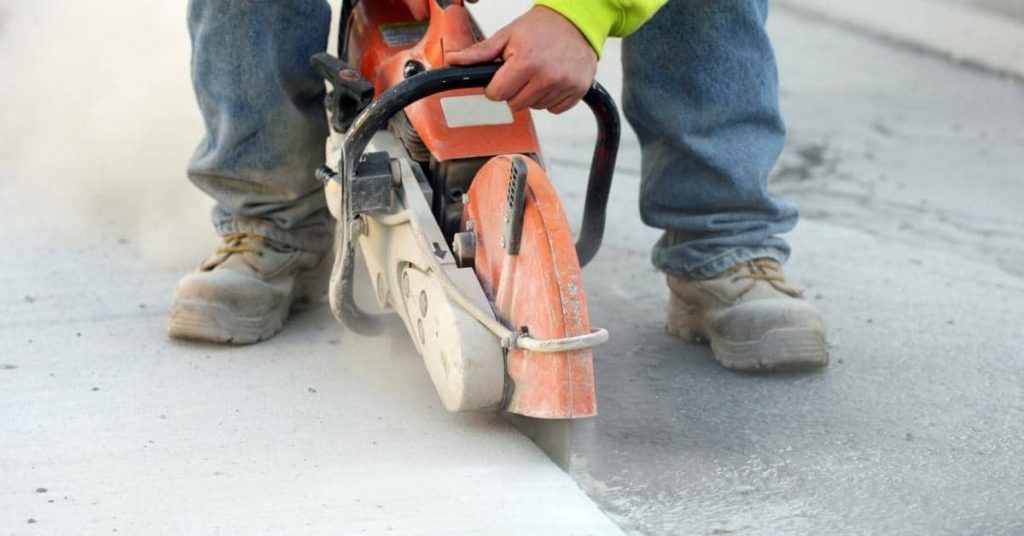
- Handheld cut-off saw: May suit deeper cuts within its rated capacity, but use several controlled passes. One manufacturer manual, for example, lists approximately 4.6 inches of maximum depth with a 14-inch blade and 5.7 inches with a 16-inch blade; verify your own saw’s rating in the operator’s manual.
- Walk-behind saw: Better for long, straight cuts, repeated deep passes, thick slabs, or work beyond the stable, rated capability of handheld equipment. Rent one only if you can follow its setup, water or extraction, and operating instructions.
- Diamond blade: This is the usual blade type for concrete and masonry. Choose a blade specifically marked for the material and intended wet or dry use; a diamond turbo blade product specification is an example of the material-specific labeling to look for.
Hand and alternative tools (chisels, sledgehammer, rotary hammer)
- Chisel and hammer: Useful for small, controlled breakout after saw cuts have freed the section. Wear eye protection and work away from the remaining edge.
- Sledgehammer: Use only on a section that is fully separated and supported. Do not strike near an edge you need to preserve.
- Rotary hammer: Useful for drilling holes or chipping small nonstructural areas with the correct bit or chisel attachment. It is not a replacement for a straight saw cut.
Blades, dust-control gear, and supporting materials checklist
- Compatible diamond blade: Verify material, diameter, arbor, maximum RPM, and wet/dry rating. Inspect it for damage before use.
- Guard and shroud: Keep the saw’s specified guard installed and correctly adjusted. Use a dust shroud only as approved for that tool and cutting method.
- Dust control: Set up either a wet-rated cutting system or a properly connected HEPA-filtered vacuum system before starting.
- Electrical protection: Use appropriate outdoor/wet-location-rated cords and connections where applicable, GFCI protection, and cord routing away from the cut and wet area.
- PPE: Impact-rated eye protection, hearing protection, gloves, sturdy footwear, and suitable clothing. Respiratory protection may also be required; it does not replace source control.
- Layout and containment: Chalk, straightedge, guide, tarps or barriers, a slurry-collection plan, and supports for any removable section.
Quick rule: Water is not automatically safe for every concrete-cutting tool. Use it only when the saw, blade, guard, and electrical arrangement are designed for wet cutting.
Safety Precautions You Can’t Skip
Concrete cutting creates flying fragments, noise, kickback risk, and respirable crystalline silica dust. Set up engineering controls first, then add PPE. Keep the blade guard in place, disconnect power before blade changes or inspection, and stop immediately if the blade binds, the tool vibrates unusually, or the cut begins to crack or move unexpectedly.
Silica dust control: wet cutting vs HEPA vacuums
Use water only with equipment specifically designed and positioned for wet cutting. Keep plugs, connectors, switches, and the tool’s electrical components out of standing water and slurry; stop if water reaches them. For dry cutting, use a compatible shroud and HEPA-filtered vacuum as directed by the tool manufacturer.
For indoor work, isolate the area and control dust at the cut. Open windows or a fan alone does not control silica dust and can spread it through the building. NIOSH recommends source controls such as water, local exhaust, and enclosure for cut-off-saw work; review its guidance on engineering controls for silica from cut-off saws.
A disposable filtering facepiece is not a universal solution. Respirator selection depends on exposure, duration, and the effectiveness of water or extraction controls. Where a tight-fitting respirator is used under applicable requirements, it needs a clean sealing surface, medical evaluation, fit testing, training, and a respiratory-protection program.
Personal protective equipment and safe handling of tools
- Eye and face protection: Wear impact-rated safety glasses; add a face shield when flying fragments are possible.
- Hearing protection: Use earplugs or earmuffs appropriate for the tool’s noise.
- Footwear and clothing: Wear sturdy, closed-toe footwear and clothing that does not catch on the tool.
- Respiratory protection: Use only as part of an appropriate dust-control plan, not instead of water or extraction.
- Tool control: Maintain a balanced stance and two-handed control where the tool requires it. Never remove a guard or force the blade.
Site setup: barriers, ventilation, and crowd control
Clear tripping hazards, protect nearby finishes, and establish an exclusion zone for bystanders. Route cords so they cannot be cut, pulled into the blade, or laid in water. If wet cutting, plan where slurry will collect before turning on the water; do not allow it to run to a storm drain, household drain, soil, or waterway.
Step-by-Step How-To: Cutting Concrete for DIYers
Use this process only for a confirmed nonstructural cut that is within the tool’s rated capacity. The goal is a controlled cut and a stable remaining slab—not simply getting through the concrete as quickly as possible.
Step-by-Step Process
- Confirm the cut is appropriate. Verify the slab is nonstructural, locate utilities, identify the required depth, and stop if reinforcement or post-tensioning is possible.
- Mark and plan the removal. Mark perimeter lines with a straightedge or chalk line. For a section to be removed, plan relief cuts and an exit path so material will not trap the blade or remain unsupported.
- Inspect and set up. Fit a compatible diamond blade, confirm the guard is in place, inspect cords and controls, establish barriers, and test the water or HEPA extraction system before cutting.
- Make a shallow guide pass. Start on the line with a light, controlled pass. Keep the tool stable and let the blade establish the kerf.
- Deepen in successive passes. Increase depth gradually, following the tool and blade instructions. Do not lower the blade abruptly, twist it in the kerf, or apply enough force to slow or bind it.
- Add relief cuts before breakout. For removal, make additional cuts that divide the section into manageable pieces. Avoid undermining or striking an unsupported slab edge.
- Break out only freed pieces. Start from a free edge or the center of a fully cut section, using controlled chisel or hammer work. Stop if the material will not release as expected.
- Inspect before finishing. Confirm the cut follows the line, reaches the intended depth, and has not caused uncontrolled cracking or movement. Only then smooth a nonstructural edge if needed.
Prep, Layout, and Scoring the Cut Line
Measure from a reliable reference and mark both ends of a straight cut before snapping or drawing the line. Check the planned blade depth against the slab thickness and the tool’s maximum rated cut depth. Cover nearby surfaces and set containment before dust or slurry can escape.
Making the Full Cut (Technique, Speed, Cooling)
Begin with the shallow guide pass, then deepen the same kerf in steady passes. Keep the saw aligned with the cut; do not side-load the blade to correct a wandering line. If the blade slows, smokes, binds, or produces excessive vibration, release the trigger, wait for it to stop, isolate power, and inspect the blade, kerf, and dust-control setup.
Use water continuously only on a wet-rated system and only in the manner specified by its manufacturer. Otherwise, use approved dry dust extraction. Never work with energized equipment in standing water or slurry.
Breaking Out, Finishing Edges, and Cleanup
Perimeter cuts alone may leave a large piece trapped by its weight or by uncut material below. Add relief cuts first, then remove smaller pieces without prying against an edge you intend to keep. If reinforcement appears, stop. Do not cut or remove rebar as a DIY workaround until a qualified professional has confirmed that doing so will not affect the structure.

Special Situations and Techniques
Cutting reinforced concrete and dealing with rebar
Unexpected steel is a stop condition. Reinforcement may be structural, and post-tensioned members can contain stored force. Do not expose, cut, pull, or attempt to remove rebar with pliers or bolt cutters. Obtain professional evaluation, particularly for any slab, beam, column, foundation, retaining wall, or unknown assembly.
Indoor cutting and confined-space considerations
Indoor cutting needs source control, containment, and a cleanup plan before work begins. Use wet cutting only where the equipment and electrical setup are wet-rated and slurry can be contained. Otherwise use manufacturer-approved local extraction with HEPA filtration. Do not direct fans across the cut toward occupied rooms; if effective containment and source control are not practical, hire a professional. Related guidance: How to Use Shellac Primer Safely Indoors: Ventilation and Cleanup for DIYers.
Small slabs vs large driveways and structural elements
A handheld saw can be appropriate for a short cut that is within its rated depth and can be made in stable, controlled passes. Use a walk-behind saw or contractor when the slab is thicker than the handheld tool’s capacity, the cut is long or must be very straight, repeated deep passes become difficult to control, or reinforcement is expected. Do not DIY-cut structural elements.
Common Mistakes to Avoid
Wrong blade, rushing, and overcutting
Do not use a blade with an incompatible arbor, diameter, material rating, wet/dry rating, or RPM rating. Keep the guard installed. Make a guide pass, deepen gradually, and let the blade cut at its intended feed rate instead of forcing it. Stop rather than twisting a pinched blade free while it is running.
Skipping dust control or PPE
Do not rely on a dust mask, open windows, or a fan as the main silica control. Set up water or HEPA extraction at the source, isolate bystanders, and use appropriate PPE. Do not dry sweep concrete dust or blow it with compressed air.
Poor planning and not knowing when to call a pro
Stop and call a professional for unknown slab thickness, structural or suspended concrete, post-tensioning, utilities, unexpected reinforcement, uncontrolled cracking, a cut deeper than the tool’s rated capability, or a removal that could destabilize adjacent concrete.
After the Cut: Cleanup, Disposal, and Next Steps
Cleaning, patching, and preparing for follow-up work
Shut down the tool, disconnect power, and let the blade stop completely before moving equipment. For dry residue, use a properly equipped HEPA-filtered vacuum or a wet method that prevents dust from becoming airborne. Do not dry sweep or use compressed air.
For wet cutting, contain slurry with tarps, berms, or collection containers. Allow solids to settle where appropriate, collect the residue, and dispose of solids and wash water according to local rules. Do not hose slurry into a drain, onto soil, or into a waterway.
Inspect the remaining slab before patching or installing anything at the cut. Look for unintended cracks, loose edges, movement, or exposed steel. A structural repair or uncertain edge needs professional advice before it is covered.
Environmental impact and eco-friendly disposal tips
Keep concrete rubble, dust, and slurry contained. Many areas accept clean concrete at recycling facilities, but acceptance and disposal requirements vary. Check the receiving facility and local waste rules before hauling debris.
Estimating cost: DIY vs hiring a contractor
Compare the cost of the correct saw, compatible blade, dust-control equipment, electrical protection, containment, disposal, and your time—not just a rental rate. A contractor is often the safer choice when the cut is deep, long, reinforced, indoors, or near structures and utilities.

Conclusion
A successful DIY concrete cut is planned around the slab’s function, the required depth, and the saw’s documented capability. Use a compatible diamond blade, keep the guard installed, control silica at the source, make progressive passes, and contain all dust and slurry.
When the concrete is structural, reinforced, post-tensioned, unknown, too thick for the tool, or difficult to control safely, stop and hire a qualified concrete-cutting professional.
FAQ
How deep can I cut concrete with a handheld saw?
Use the maximum cut depth stated for your specific saw, blade, and guard. Make multiple controlled passes rather than trying to force a deep cut in one pass. If the slab exceeds that rated depth, or the cut is long or difficult to keep straight, use a walk-behind saw or hire a professional.
Can I use water with any concrete-cutting tool?
No. Use water only when the saw, blade, guard or shroud, and electrical arrangement are designed for wet cutting. Keep electrical components and connections out of water and slurry. A dry-only tool needs its approved dry dust-extraction setup instead.
What should I do if I hit rebar or steel?
Stop cutting and have the assembly evaluated. Do not assume exposed reinforcement can be removed safely; it may be structural or part of a post-tensioned system.
How should I clean concrete dust and slurry?
HEPA-vacuum dry residue or use a wet method that keeps dust from becoming airborne. Contain wet slurry, collect it, and follow local disposal rules. Do not dry sweep, use compressed air, or wash slurry into drains or waterways.