

Introduction
You can pour a small, nonstructural slab-on-ground pedestrian ramp yourself only after establishing what the ramp is for and what design detail governs it. An accessibility ramp, vehicle ramp, attached ramp, retaining ramp, and ramp on questionable soil do not share one safe thickness, base, reinforcement, or slope detail. This guide explains the practical sequence for a simple pedestrian ramp on stable ground and the conditions that require a qualified designer or concrete professional. Related guidance: Concrete Stair Landing Drainage: Small Slope Details That Prevent Puddling.
Key takeaways
- Identify the ramp type, users, loads, applicable code, permits, utility locations, finished elevations, drainage, and transitions before excavating.
- For a private pedestrian ramp with no adopted or engineered section detail, stop before digging: do not invent slab thickness, base thickness, reinforcement, or joint dimensions.
- Build only on firm, drained support. Remove organic material, mud, loose fill, and soft pockets; place and compact base in the specified lifts and verify grade before forms go in.
- Plan forms, joints, reinforcement, crew, delivery or mixing, finishing tools, curing materials, weather protection, and safe access before concrete arrives.
- Do not add water casually, leave reinforcement on the base, over-vibrate, or resume an interrupted pour as though an unplanned cold joint does not matter.
- Stop for unstable ground, unsafe access, moving forms, unsuitable weather, an unmanageable placement, or a slope, drainage, or structural-detail error.
Table of Contents
- Introduction
- Key takeaways
- Quick overview and legal requirements
- Tools, materials, and specs
- Site assessment and preparation
- Formwork, reinforcement, and expansion planning
- Step-by-step pouring and finishing process
- Curing, protection, and inspection
- Common mistakes, troubleshooting, and maintenance
- Conclusion
- FAQ
Quick overview and legal requirements
Classify the ramp before selecting dimensions
First identify whether this is a private pedestrian ramp, an accessible route, a vehicle or driveway ramp, or another purpose. Do not use a pedestrian slab assumption for a vehicle ramp. Before excavation, ask the local building department and, where applicable, zoning or public-works office whether building, grading, drainage, right-of-way, accessibility, or inspection requirements apply. Model codes apply only when adopted and amended by the jurisdiction; a permit exemption does not override other local rules.
Design before DIY: proceed only when the ramp is clearly limited
| Condition | DIY decision |
|---|---|
| Small private pedestrian ramp, on stable undisturbed ground, with no retaining function, structural connection, or vehicle loading | Proceed only with an adopted local residential detail or a written detail from a qualified concrete professional that identifies slab thickness, base material and thickness, compaction method, reinforcement if any, and joint layout. |
| No detail for thickness, base, reinforcement, or joints | Stop. Obtain that detail before excavation. Do not treat a quantity example or a generic internet minimum as a design. |
| Vehicle or equipment loads; poor, wet, expansive, fill, or frost-susceptible soil; settlement; retaining edge; attachment to a building; elevated or suspended work; structural handrail anchorage | Professional design required. |
Accessibility ramps
If the project is an accessible route subject to the 2010 ADA Standards, a ramp run generally has a maximum running slope of 1:12, a maximum rise of 30 inches per run, and a minimum 36-inch clear width. Landings, cross slope, door maneuvering clearance, edge protection, and handrails also matter. Handrails are generally required where a ramp run rises more than 6 inches. Confirm the project classification and applicable local requirements using the 2010 ADA Standards for Accessible Design; state and local residential rules may differ.
Required horizontal run equals vertical rise divided by the slope ratio. For example, a 24-inch rise at 1:12 requires 24 feet of ramp run, excluding landings. Under ADA, a walking surface at 1:20 or flatter is classified differently from a ramp; that distinction does not by itself establish all local design requirements. The 1:48 figure concerns maximum cross slope, not a general running-slope target.
Set finished elevations before digging
Measure the actual rise from the finished lower transition to the finished upper transition. Use stringlines or a laser to set both ends and intermediate checkpoints. Account for the designed slab and base section, landings, door thresholds, and adjacent grades. Verify that the finished surface drains without creating a trip, ponding at a door, or directing water toward a foundation.
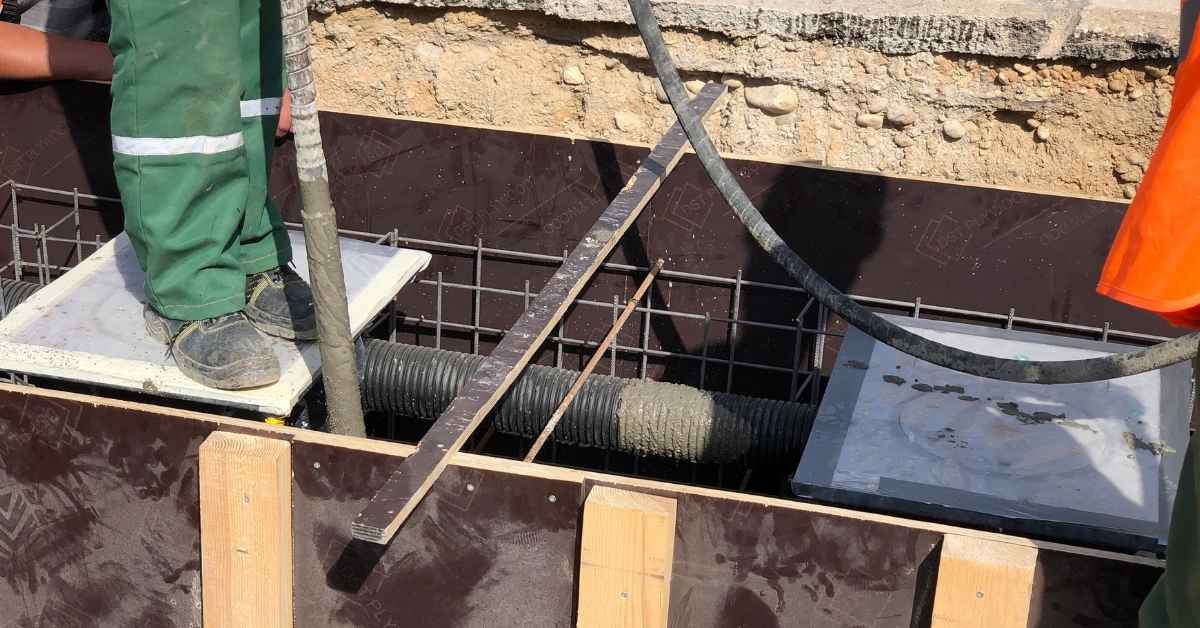
Tools, materials, and specs
Tools, materials, and PPE
- Tape measure, level or laser, stringline, stakes, marker, square, and an elevation plan.
- Excavation tools; the specified base material; and a compactor when required by the selected detail.
- Form lumber or plywood, stakes, braces, fasteners, form-release agent, and isolation material where the slab meets fixed construction.
- Specified reinforcement, chairs or spacers, jointing tools or saw equipment, and any secured drains, sleeves, or embeds.
- Shovels, come-along, straight screed, bull float, edger, groover, broom, curing materials, weather protection, barriers, and a planned washout area.
- Alkali-resistant gloves, waterproof boots, eye protection, and long sleeves. Wet concrete can cause chemical burns.
- For dry cutting, grinding, or dusty mixing, avoid dry dust whenever possible: use a wet method or a properly functioning dust-collection system that fits the tool and follow local occupational-safety requirements. Respiratory protection is not a substitute for dust control and should be used only within an appropriate respiratory-protection program.
Choose the mix and reinforcement for the actual job
Use a mix identified by the ready-mix supplier, selected bagged-product instructions, local code, or design detail for the exposure and placement. Freeze-thaw exposure may require air entrainment; verify exposure requirements with the supplier. Mix strength, aggregate size, slump, admixtures, thickness, and reinforcement are not one-size-fits-all decisions.
Order the lowest slump that can be placed and consolidated for the forms, slope, reinforcement, tools, and crew. Workability depends on placement complexity, reinforcement congestion, admixtures, and consolidation. Higher slump is not automatically better, and an approved water-reducing admixture may be preferable to adding water. See the American Concrete Institute guidance on slump and workability. Follow the supplier’s or bagged product’s water limit, mixing time, yield, and working-time instructions; do not casually add water at the site.
Welded wire reinforcement and reinforcing bars are different products, not interchangeable descriptions. If the governing detail requires reinforcement, it must state the product designation or bar size, spacing, laps, cover, placement elevation, and support method. Put it on chairs or spacers; steel left on the base does not provide the intended position. If those instructions are absent, stop and obtain a detail. Reinforcement does not prevent all cracking, so support and joints still matter. Related guidance: Concrete Step Riser Cracks: Why They Appear and Which Fixes Are Real Fixes.
Calculate concrete and plan delivery
For a ramp with constant slab thickness, volume equals length × average width × thickness. Convert inches to feet, then divide cubic feet by 27 for cubic yards. Add separate quantities for landings, thickened edges, curbs, or footings. A 5–10% planning allowance may account for uneven excavation, spillage, and waste; it is an estimate, not a code requirement.
Quantity math only—not a thickness recommendation: a 20-foot-long, 4-foot-wide ramp at 4 inches thick is 20 × 4 × 0.333 = 26.7 cubic feet, or about 0.99 cubic yard. With a 10% allowance, that is about 1.1 cubic yards. This example does not select the slab thickness, base, reinforcement, or joints.
For ready-mix, confirm order volume, minimum load, truck capacity, delivery interval, truck access, turning space, overhead clearance, ground bearing, chute or pump reach, washout location, wheelbarrow route, and backup route. Assign enough people to place, screed, edge, joint, texture, and start curing without delay. Do not start if the truck, pump, chute, mixer, or crew cannot complete the placement safely within the workable window.
Site assessment and preparation
Prepare the support in order
- Locate utilities and establish work routes. Mark utilities before digging. Establish the excavation limits, spoil route, concrete route, washout area, and an escape route that does not trap anyone between forms, truck, chute, excavation, or slope.
- Excavate to the designed section. Excavation depth equals the designed slab thickness plus the specified base depth, adjusted for finished elevations. Remove organic material, mud, loose fill, and soft pockets. Do not use a universal excavation or base depth.
- Establish drainage. Keep runoff out of the excavation and correct any condition that sends water toward the building, under the slab, or onto the finished ramp.
- Inspect the exposed subgrade. It must be firm, shaped to support the planned section, and free of standing water. Stop for pumping, rutting, rocking, mud, soft pockets, saturation, frozen material, or unexplained fill. Correction may require removal and replacement or professional evaluation; do not simply compact over a failing area.
- Place the specified base. Spread the selected base in the lift thickness required by its specification or compactor instructions. Keep each lift reasonably uniform; do not bridge a hollow or bury a soft pocket.
- Compact and verify each lift. Compact using the specified method, then check elevations with stringlines or a laser before placing the next lift. A percentage compaction value is meaningful only with its stated density test and specification. The FHWA guidance on concrete pavement bases and subbases illustrates why compaction requirements depend on material and test method rather than a universal 90% or 95% number.
- Confirm the completed support. Before forms or reinforcement, recheck base elevation, slope, drainage, and firmness. There must be no standing water, pumping, rutting, rocking, or soft area under reasonable test loading. If there is, correct the support or obtain professional advice before proceeding.
Pre-pour sign-off
- Ramp type, intended loads, code questions, permits, utility clearance, and any inspection requirements are resolved.
- Rise, running slope, cross slope, width, landings, transitions, and drainage are measured from finished elevations.
- The slab, base, reinforcement, isolation, and joint detail is available and matches the project.
- Subgrade and base are firm, drained, compacted by the specified method, and at the correct elevation.
- Forms are braced, aligned, and treated with release agent; reinforcement, joints, isolation material, drains, sleeves, anchors, and embeds are secured.
- Concrete quantity, access, washout, crew tasks, tools, curing materials, protection, and safe escape routes are ready.
Weather go/no-go check
Before ordering, read the curing and weather section of the selected bagged-product technical data or get the ready-mix supplier’s written guidance. Confirm the minimum concrete temperature, rain restrictions, approved curing method, hot/dry/windy placement controls, and required early-freezing protection. Also confirm the forecast, expected concrete temperature, rain timing, wind, sun, humidity, and whether the crew can place, finish, joint, and begin curing continuously.
Reschedule unless an experienced concrete professional has a workable protection plan when rain is expected during placement or before the surface hardens; the subgrade, base, or forms are frozen, saturated, muddy, or unstable; early freezing is possible; or heat, wind, low humidity, and direct sun could dry the surface faster than the crew can finish and cure it. Do not use a narrow ambient-temperature range as a universal rule.
Formwork, reinforcement, and expansion planning
Build forms to the finished surface
Use straight, sturdy form material and enough stakes and braces to resist concrete pressure without movement. Set form tops to the finished ramp grade, not simply level. Check both edges, width, transitions, landings, and intermediate elevations with a stringline or laser. Push or pull-test braces before the truck arrives; any flexing or movement means add bracing and recheck grade. Apply release agent to form faces only, keeping it off reinforcement and bonding surfaces.
Install isolation, reinforcement, and the joint plan
Use the governing detail to mark control-joint locations and required depth before placement. That detail m