

Introduction
The essential tools for laminate flooring are the handful you actually need to make clean cuts and tight joints. Focus on practical, reliable options that fit your space and budget. Check the product label and manufacturer guidance for any tool-specific safety notes.
Common options include a utility knife, a tapping block, and a saw that suits your laminate thickness. Keep blades sharp and tools in good condition, and use them as directed to avoid chipping or loose joints. Always follow local rules and basic safety practices on the jobsite.
Key takeaways
- Ensure sharp blades and controlled cuts with a scoring knife and laminate cutter.
- Use a straight edge and full-extension rule for layout accuracy.
- Dry-fit boards first, check for gaps and transitions before final adhesive.
- Wear eye and hearing protection; protect surfaces to reduce debris and hazards.
- Maintain consistent spacing using spacers to keep joints uniform.
- Inspect tools for wear; replace dull blades and worn guides promptly.
Table of Contents
- Introduction
- Key takeaways
- Overview: Why the Right Tools Matter
- Essential Cutting Tools
- Tools for Precise Measurement and Layout
- Jigs, Guides, and Work Supports
- Fastening, Joining, and Edge Preparation Tools
- Finishing, Trim, and Transition Tools
- Safety, Dust Control, and Environmental Considerations
- Troubleshooting Common Problems and Tool Maintenance
- Conclusion
- FAQ
Overview: Why the Right Tools Matter
The right toolset makes a noticeable difference in cut quality and joint tightness. It also speeds up installation and helps the floor perform as intended over time. Skipping or improvised tools often leads to gaps, chipping, or premature wear that shows up in high traffic areas.
Choosing the correct combination of tools helps you avoid common pitfalls. A thoughtful setup reduces surprises at the end of the job and keeps edges clean and accurate. When in doubt, consult the tool label or manufacturer instructions before you cut or fit any laminate pieces.
How tool choice affects fit and finish
The right tools ensure your laminate floor looks great and performs well for years.
- Jigsaw or Multitool: For clean, precise cuts. Choose one with a T-shank blade for stability. Rent: $20-$30/day
- Miter Saw: For perfect 45° angles on transitions. Top models cost around $150.
- Claw Hammer: Gently tap pieces into place, avoiding damage. Under $20
- Tapping Block: Protects flooring from hammer blows. $5-$10
- Pull Bar: Tightens joints for a snug fit. Around $30
- Clamps: Keeps pieces steady during gluing. $10-$20 each
- Measuring Tape: Accurate cuts prevent waste and gaps. Under $15
- Pencil: Marking lines ensures precise cutting. Under $3
- Safety Glasses: Protects eyes from debris. Around $5
Cost vs. quality tradeoffs
You don’t need to break the bank, but investing in key tools pays off.
Must-haves: Jigsaw or multitool, miter saw, pull bar, clamps. These ensure clean cuts and tight joints.
Consider renting expensive tools like a high-end miter saw for complex cuts. It’s cheaper than buying, but plan ahead to avoid delays.
Budget-friendly: Claw hammer, tapping block, measuring tape, pencil are affordable yet essential. Safety glasses protect your investment – you!
Essential Cutting Tools
Identify the primary cutters and saws you’ll rely on for laminate work. Different cuts affect edge integrity and overall accuracy, so match the tool to the task. Use steady, controlled motions to minimize tearout and chipping along the exposed edge.
Focus on techniques that protect the edge, such as scoring before full cuts or using a guide for straight runs. Check the tool’s instructions and test on scrap pieces to confirm you’re getting clean edges before you commit to the final layout.
Manual saws and snap cutters
Hand tools like manual saws and snap cutters are your go-to when you need precision, control, or don’t want to haul out power tools. They’re ideal for tight spaces, small cuts, and intricate patterns.
Manual saws, such as miter boxes with backsaws, give you clean, precise cuts. Use slow, steady strokes, and keep the blade perpendicular to the board.
Snap cutters are perfect for quick, simple cuts like trimming laminate strips to width. Apply even pressure, and let the tool’s mechanism do the work.
For both tools, use a sharp blade and apply minimal force to prevent chipping or splintering.
Power saws and portable cutters
When you need speed and versatility, power tools like miter saws, circular saws, and jigsaws are your friends. They tackle straight cuts, angled cuts, and even curves.
Miter saws excel at quick, accurate straight and angled cuts. Choose one with a blade guard for safety and a laser guide for precision.
Circular saws are great for long, straight cuts on large boards. They’re portable, but keep them level to avoid wobbling.
Jigsaws are perfect for curved cuts and intricate patterns. Opt for one with an orbital action blade for smooth cutting.
Blade selection and anti-chip techniques
Choosing the right blade is crucial for clean cuts and edge integrity. For laminate, use blades with many teeth (TPI) – at least 60 or more.
Use fine-tooth blades to minimize chipping and splintering. They create a smoother cut but may take longer.
To further prevent chipping:
- Apply sacrificial backers – thin strips of plywood or hardboard – on the waste side of your cut to distribute force and protect edges.
- Use masking tape along the line you’re cutting. It helps hold the board together and reduces chipping.
Tools for Precise Measurement and Layout
Accurate measurement and careful marking are the backbone of tight joints. Keep a simple set of layout tools ready for quick checks along long runs. Plan end-piece widths and transitions early to prevent last‑minute adjustments.
Use layout strategies that minimize cumulative error and verify references often. When reading specifications or data sheets, pause to confirm how your chosen tools translate to actual cut lines on the floor.
Measuring tools and accuracy checks
When it comes to measuring, you’ve got three main tools: tape measures, straightedges, and laser measures. Each has its place, so let’s dive in.
Tape Measures: These are your basic, everyday tools. They’re cheap, easy to use, and perfect for quick, simple measurements. But remember, they can stretch over time, so always check the zero point. For critical measurements, consider using a tape measure calibrator.
Straightedges: You’ll need these to draw lines and check if something’s square or level. Get a good quality one, at least 4′ long for most jobs. Check it regularly by laying it across two points and measuring the gap with your tape measure – it should be even all along.
Laser Measures: These are your high-tech option, great for long distances or when you need pinpoint accuracy. They’re not cheap, but they’re worth it for big jobs. Always check the battery life before starting and recalibrate if it seems off.
Layout lines, templates, and marking aids
Before you start cutting or drilling, use this checklist to ensure your layout is accurate and consistent. This will save you time, materials, and rework.
- Check chalk line level: Ensure the chalk box is filled with enough chalk and the line is straight by checking it against a level or square. A wonky line can lead to crooked cuts.
- Test snap line tension: Pull the string taut and release it. It should snap back quickly and evenly. If not, adjust the tension screw or replace the string.
- Verify story stick length: Measure your story stick against the actual dimension to ensure it’s correct. Using the wrong stick can result in incorrect cuts.
- Check template fit: Dry-fit your template on the material before cutting. Ensure it fits snugly and covers the entire cut area. A loose or misfit template can cause inaccurate cuts.
- Mark center points: Use a combination square or speed square to mark the center of each piece. This helps maintain alignment when assembling.
- Verify layout against plans: Double-check your layout lines and marks against your building plans. A small mistake here can cause big problems later on.
- Test marking tool visibility: Make a test mark on the material to ensure it’s visible enough for cutting but not so dark that it affects the finished look.
- Check layout in both directions: Ensure your layout lines are correct from both sides. This is especially important when working with two-piece assemblies like doors or windows.
Quick rule: Always double-check your layout before you start cutting. A few extra minutes spent checking can save hours of rework and material waste.
Spacers, wedges, and gap control
Keeping expansion gaps consistent and joints tight is a game of millimeters. Here’s how to do it right:
Spacers are your best friends here. They come in various sizes (usually 1/8″ to 1/2″), so check your tile or stone size and pick the right one. Too small, you’ll have a tight squeeze; too big, you’ll end up with gaps that look like they’ve been through a war.
Lay out your spacers as you go. Place them between tiles or stones, not at the edges. This way, when you remove them after the mortar sets, you won’t have any surprises. And remember, consistency is key. If you’re using different sizes of tile or stone, adjust your spacer size accordingly.
Now, about those wedges. They’re not just for show. Use them to keep your tiles or stones tight against the wall. But don’t go crazy – use just enough pressure to hold things in place. Too much, and you’ll crack something. Check your manufacturer’s instructions if you’re unsure.
Jigs, Guides, and Work Supports
Shop-made jigs and commercially available guides can improve repeatability and safety. A simple edge guide or stop block can help you reproduce consistent cuts. Supports that cradle the plank reduce movement during cutting and prevent dangerous kickbacks.
Include DIY jig ideas like basic clamping rails or sanding blocks that keep planks flat while you work. Always test any jig on scrap pieces first and adjust for smooth, even cuts across the length of the plank.
Rip Guides, Crosscut Sleds, and Fences
These jigs are game-changers for straight cuts. Here’s how:
Rip Guides: Keep your saw running in a straight line. Clamp it to your workpiece or fence.
Crosscut Sleds: Stop your blade at the right depth, every time. Set it up once, then slide your planks through.
Fences: Keep cuts consistent. Align your fence with your blade’s kerf for perfect repeatability.
Workbench Supports and Sawhorses
Stable support makes clean cuts. Here’s what works:
Workbench: Use it for precision work. Clamp your plank down, keep it steady.
Sawhorses: Great for long pieces. Use two, space them evenly. Add a support in the middle for extra stability.
For both, keep your workpiece off the ground. This reduces vibration and prevents warping.
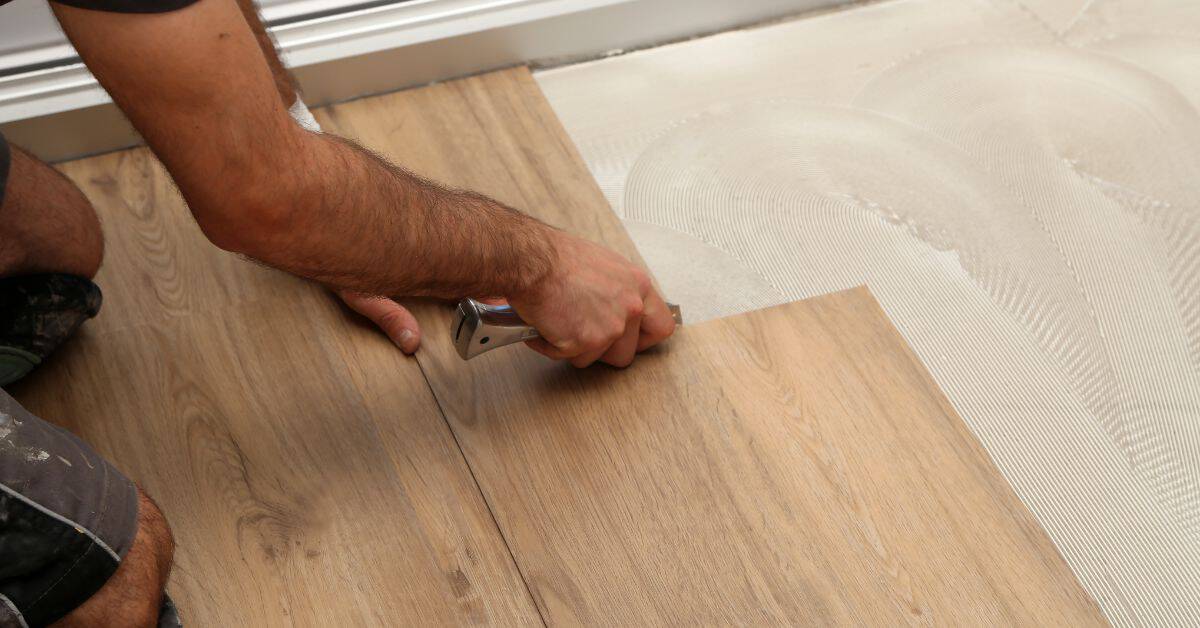
Fastening, Joining, and Edge Preparation Tools
Use the right tools to join planks tightly and prepare edges for tricky fits. This includes methods for tightening joints and smoothing edges before installation. Identify whether a mechanical or adhesive approach is appropriate for the situation you face.
Explain when tapping with a pull bar or tapping block is enough versus when you need to apply adhesive or edge sealer. Check the product instructions and local rules to ensure you’re using the proper method for your flooring system.
Tapping blocks, pull bars, and mallets
To lock joints tightly without damaging tongues and grooves, use tapping blocks, pull bars, and mallets. Here’s how:
Tapping Blocks: Place these between the wall and the plank before tapping to prevent damage. Tap gently but firmly with a rubber mallet.
Pull Bars: Use these for long planks that need extra persuasion. Insert into the groove, then pull while tapping the block.
Mallets: Choose a rubber mallet over a metal one to avoid damaging the flooring. Tap with moderate force; too much can break tongues or grooves.
Adhesive application and seam sealing tools
Applying adhesives and sealants neatens joints, improves strength, and boosts moisture resistance. Here are essential tools:
- Notched Trowel (6-in-1): Applies adhesive evenly in grooves. Use the 1/8″ or 3/16″ notch for most laminates.
- Seam Sealer Gun: Applies sealant to gaps, preventing moisture intrusion. Rentable; expect around $50/day.
- Caulking Gun: For applying sealant to expansion gaps and wall edges. Use a 10:1 ratio gun for better control.
- Adhesive: Choose one suitable for your laminate type (wood, stone, etc.). Follow package instructions for application and drying times.
- Sealant: Opt for a paintable, low-odor sealant. Apply only after adhesive has dried to avoid contamination.
Edge prep: chamfering and nibbling tools
For irregular areas, light edge shaping or shaving helps planks seat without compromising joints. Here are useful tools:
- Chamfer Bit (Router): Creates a 45-degree bevel on edges. Use with a router and guide for consistent results.
- Nibbling Tool (Jigsaw): For intricate edge shaping, use a jigsaw with a nibbling tool attachment. Go slow to avoid splintering.
- Hand Plane: Shaves off thin layers of wood for fine-tuning edges. Use carefully to avoid removing too much material.
- File or Sandpaper: For minor edge adjustments, use a file or sandpaper to smooth and shape.
- Router Table (Optional): For precise edge shaping, consider renting a router table ($20-$40/day). It provides consistent results and better control.
Finishing, Trim, and Transition Tools
Trimming door casings and fitting thresholds require precise tools and careful technique. Plan for undercutting and coping to achieve clean transitions between rooms. Install reducers and other transitions with snug, even gaps for a professional look.
Keep a small set of finish tools handy to handle minor alignment adjustments. Verify the dimensions and fit against the manufacturer’s guidance or your project measurements before final securing.
Routers and multi-tools for undercutting
Undercutting doorjambs allows you to install trim without visible gaps. Here’s how to do it right:
Choose the right tool: A plunge router or a multi-tool like a Fein SuperCut is best for undercutting. They let you control depth and make smooth cuts.
First, mark your cut line with a pencil. Then, set your tool’s depth to match the thickness of your trim plus an extra 1/32″ for clearance. Start at one end of the jamb and plunge down, following your line. Keep the tool level and steady.
Watch your depth: Go slow and check your progress often. It’s easier to take off a little more than it is to fix an overcut. If you do slip, stop, assess the damage, and decide if you need to replace the jamb or try to repair it.
Once you’re done, sand any rough edges with a fine-grit sandpaper. Then, install your trim as usual. Remember, undercutting is a precision job. Take your time and check your work often.
Measuring, cutting, and fastening transitions
First things first, check your transition type. You’ve got thresholds for level changes, reducers for slight drops. Make sure you know what you’re dealing with.
Now, let’s talk measuring. You want a smooth transition, right? So, measure accurately. Use a tape measure, not your eye. Mark the cut line clearly. Remember, it’s easier to take off more than put on too much.
Time for cutting. If you’ve read this far, I’m guessing you know about routers and multi-tools from earlier. Use them to make your cuts. Follow the marked line. Go slow, steady wins the race here. Once cut, sand any rough edges. Safety first, wear a mask.
Now we’re ready for fastening. You’ve got options – screws, adhesive, or both. If using screws, predrill holes to prevent splitting. Use the right size screw, not too long, not too short. If gluing, use a construction adhesive designed for your transition type. Always follow manufacturer’s instructions.
Safety, Dust Control, and Environmental Considerations
Personal protective equipment protects you from dust and debris during cutting and fitting. Establish dust control with a combination of local ventilation and containment strategies suited to the space. Even small jobs benefit from a plan to keep dust from migrating to adjacent areas.
Use practical, low-tech containment when needed, and adapt as the room size and layout dictate. When in doubt, follow the bottom-line safety guidance from the tool and material labels or manufacturer recommendations.
Personal protective equipment and safe practices
Safety should always be your top priority when installing laminate flooring. Here’s what you need to protect yourself and others.
- Ear protection: Laminate cutters can be loud. Use foam or earmuffs to protect your hearing.
- Eye protection: Safety glasses or goggles will shield your eyes from debris and dust.
- Dust mask: A respirator with a P100 filter will protect you from harmful particles. Change it regularly.
- Work gloves: Protect your hands with durable, non-slip gloves to handle materials safely.
- Knee pads: Optional but helpful for long periods of kneeling during installation. Rentable and affordable.
Dust collection and simple containment tactics
Minimizing dust is crucial, especially when working in occupied homes. Here are some portable extraction options and quick methods to contain it.
Consider renting a HEPA vacuum with a dust extractor attachment. It’s a powerful tool that can significantly reduce airborne particles.
For small jobs or tight spaces, use zip-top plastic bags to cover cuts and collections. Poke holes for the blade, then vacuum inside as you cut.
Create simple barriers with plastic sheets or drop cloths. Tape them to walls and doors to contain dust within the work area. Remove once finished.
Troubleshooting Common Problems and Tool Maintenance
Gaps, lippage, and damaged edges are common callbacks if tools or technique aren’t aligned with the task. Start with the simplest corrective steps you can verify on a scrap piece. Regular maintenance keeps blades and bits cutting cleanly and evenly.
Decide when a repair is feasible versus when replacement is more appropriate by weighing tool wear and edge condition. Always consult repair guides, manufacturer instructions, or local rules if a component looks questionable.
Fixes for gaps, crooked rows, and edge damage
Gaps between planks can happen due to improper spacing or expansion. Crooked rows might be caused by uneven subfloor or incorrect cutting. Edge damage could occur during handling or installation.
For gaps: Use a gap filling compound. Apply with a putty knife, let dry, then sand smooth. If gap is too wide, replace the plank.
For crooked rows: Remove the problematic planks. Check your subfloor for level. Reinstall using shims if necessary or replace damaged planks.
For edge damage: Use a wood filler. Let dry, sand smooth, then apply edge banding or touch up with stain and finish.
Blade care, sharpening, and tool storage
Maintaining your blades and tools ensures clean cuts and longevity.
- Clean after use: Remove dust and debris with a brush. Wipe blade with a damp cloth to prevent rust.
- Sharpen regularly: Use a sharpening stone (around $20) or take it to a professional ($5-$10 per blade). Sharpen at 15-20 degrees for best results.
- Store safely: Keep blades in a dry place, away from moisture. Use a blade guard (around $5) to prevent accidents.
- Check teeth: Ensure blade teeth are intact and not worn down. Replace if necessary ($10-$30 per blade).
- Tool storage: Use a tool box or cabinet (around $20-$50) to keep tools organized, dry, and safe from damage.
Conclusion
Get confident that every cut, joint, and edge will hold together and look right by focusing on the right tools, proper setup, and clean technique. Safety, accuracy, and a good finish aren’t luck—you plan for them and follow through.
Now move with a quiet, deliberate routine: check your tools and blades for sharpness, dry-fit sections to confirm layout, measure twice and cut once, set up guides and supports, make light passes to establish line and depth, test a few scraps before touching the real boards, and keep the workspace clean to prevent mistakes. Work in small sections, stay aligned, and if a board doesn’t seat or a joint won’t close, stop and reassess rather than forcing it.
Common mistakes to avoid are rushing through cuts, neglecting a test cut or layout check, and skipping dust control, which can cloud vision or bind tools. Don’t skip edge prep or mitering when required, and never force a board to fit a poorly prepared space. Always use the right safety gear, unplug tools to change blades, and keep hands clear of cutting zones and moving parts.
If the project runs into uneven subfloor, persistent gaps, or complex transitions, consider a pro for the tricky corners or subfloor issues. Otherwise, tackle the next section with a steady pace, document any oddities, and finish with a tight, clean install that you can be proud of. You’ve got this—steady work now saves trouble later.
FAQ
What should I check to ensure clean, accurate cuts with laminate?
Use the blade type recommended by the laminate panel maker and fit the saw blade correctly. Check the blade for sharpness and wholeness before cutting. If in doubt, read the manufacturer instructions and compare with your tool’s label.
How can I prevent tear-out or chipping on the top surface when cutting long pieces?
Use a zero-clearance insert or backing under the cut line if your tool supports it. Score the laminate first if your material requires it, then cut with a steady feed. If you see chatter, slow down and verify the blade is suitable for laminated flooring.
Which tools help me get joints tight at walls, doorways, and transitions?
Runners, spacers, and a fine-tooth saw blade help with tight gaps. Use a square and layout gauge to keep lines true along obstructions. Always follow the tool manufacturer’s guidance for setups and any edge-clip requirements from the flooring maker.
What’s the best approach to dust control while cutting?
Attach a dust collection attachment if your saw supports it, or use a shop vacuum aimed at the cut line. Wetting the work area lightly is not generally recommended for laminate; instead, keep the space sealed and ventilated. Check local rules and tool instructions for any dust-control specifics.