

Introduction
Ceiling drywall without a lift means using hand techniques, temporary bracing, and smart cutting sequences to hold and fasten panels safely when you don’t have mechanical help. This is about controlling the panel, supporting it temporarily, and cutting in the right order so you don’t fight sag or drop a sheet. Think like a foreman: plan lifts, get helpers, and check product labels and local rules for any required fastener spacing or panel limits.
Practical tricks include clamp-and-block bracing, short-edge-first fastening, and using wedges or screws as temporary holds while you install the next sheet. These methods keep the work steady and reduce strain compared with muscling panels into place. If unsure about materials or load limits, consult the drywall manufacturer’s instructions and local building officials before you start.
Key takeaways
- Evaluate ceiling height and room layout before lifting panels or bracing.
- Plan panel control: use gradual, coordinated movements to avoid pinching fingers.
- Set temporary bracing at smart locations to prevent sagging during installation.
- Mark layout lines on joists and chalk lines for precise placement.
- Use proper screw sequence and spacing to minimize panels buckling.
- Protect yourself: wear eye protection, gloves, and keep clear of overhead drops.
Table of Contents
- Introduction
- Key takeaways
- Why Skip the Lift? When and Why to Hang Ceilings Without One
- Tools and Materials Checklist
- Prepping the Space and Layout for Ceiling Panels
- Panel Control Tricks for One-Person or Small Crews
- Temporary Bracing and Blocking Methods
- Safer Cutting Sequences and Panel Handling During Installs
- Fastening Strategy, Spacing, and Screw Sequencing
- Finishing, Inspection, and Common Troubleshooting
- Conclusion
- FAQ
Why Skip the Lift? When and Why to Hang Ceilings Without One
Some jobs simply don’t justify hauling or renting a drywall lift: short runs, tight access, scattered framing, or when the lift won’t physically fit through doorways or up narrow stairs. Consider safety, crew size, budget, and the physical layout to decide whether manual methods make sense for your project.
Check product labels, local code, and the drywall manufacturer’s installation instructions to confirm allowable panel handling and fastening for your ceiling assembly. If any requirement is unclear, ask the manufacturer or your local building department before proceeding.
Assessing job scope and safety constraints
Before you decide to hang ceilings without a lift, assess the job’s scope and safety. Here’s what to consider:
Ceiling Height: If it’s low (under 9 feet), manual methods are safer and easier.
Room Size & Access: In small rooms or tight spaces, a lift might be impractical. Check for clear paths to work safely.
Hazards: Look out for live electrical wires, plumbing, or other hazards that could pose risks during manual installation.
Cost, time, and labor trade-offs
Weigh these factors to decide if going lift-less is the right choice:
Crew Size: Smaller crews can work without a lift. More crew members might need one for efficiency.
Rental Costs: If you’re renting a lift, factor in daily rates and potential damage fees. Manual methods save these costs.
Time-on-Task: While manual installation can be slower, it’s often faster than setting up, operating, and tearing down a lift. Consider your project timeline.
Tools and Materials Checklist
Gather the core items you’ll need on the job: drywall panels, appropriate-length screws, a reliable drywall lift alternative (T-braces, scaff or ladders), battery drill, measuring tools, utility knife, T-square, and a drywall rasp. Include safety kit items like eye protection, hard hat, and a dust mask suited to overhead work.
Verify local code, the drywall manufacturer’s data sheet, and specific fastener specs before buying so thickness, fastener type, and accessory choices match the assembly. If a specification matters, check the product label or manufacturer instructions instead of guessing.
Hand tools and improvised aids
Before you start handling concrete panels, ensure you have the right tools and improvised aids to control them safely. This checklist helps you prepare.
- Tape measure: Verify it’s in good working condition with a clear scale. A broken tape can lead to inaccurate measurements, causing panels to fit poorly.
- Level: Check that your level is accurate using a known straight edge or wall. An inaccurate level results in crooked panels and costly rework.
- Safety glasses: Ensure they provide adequate protection. Damaged safety glasses can lead to eye injuries from flying debris.
- Work gloves: Check for tears or worn-out spots. Worn gloves offer less protection, increasing the risk of cuts and scrapes.
- Straps (for securing panels): Inspect each strap for fraying or damage. A broken strap can cause a panel to fall, leading to injuries or damaged panels.
- 2x blocking: Ensure it’s straight and undamaged. Bent or warped blocking won’t provide proper support, causing panels to shift or crack.
- Clamps: Test each clamp to ensure it grips securely. A loose clamp can allow a panel to move, leading to misaligned joints.
- Dolly (for moving panels): Check that all wheels roll smoothly and the dolly is stable. A wobbly dolly can cause panels to tip over or crack.
Quick rule: Always double-check your tools before starting work. Damaged tools can lead to accidents, rework, and increased costs.
Preferred fasteners, adhesives, and accessories
Use this checklist before starting any concrete work to ensure you have the right materials for a strong, durable job.
- Concrete screws (for attaching forms): Check they’re long enough to penetrate into solid wood or steel. Wrong length can cause form failure.
- Galvanized nails (for temporary blocking): Ensure they’re long enough to secure blocking firmly. Too short can lead to blocking shifting during pouring.
- Expansion bolts (for anchoring reinforcement): Verify they match the hole size and have sufficient expansion range for your application. Wrong size can result in poor anchorage.
- Epoxy adhesive: Check it’s compatible with your concrete mix and reinforcement type. Incompatibility can cause bond failure.
- Edge cleats (for supporting forms): Ensure they’re strong enough to support the form load. Too weak can cause form collapse during pouring.
- Temporary blocking: Verify it’s properly spaced and secured. Inadequate blocking can result in excessive concrete flow, leading to honeycombing or other defects.
- Concrete sealant (for preventing water ingress): Check it’s suitable for your climate and application. Wrong sealant can cause moisture-related issues like delamination or cracking.
- Form release agent: Ensure it’s compatible with your concrete mix and form material. Incompatibility can result in difficult form removal or surface defects.
Quick rule: Always check product labels, manufacturer instructions, and local rules to ensure you’re using the right fasteners, adhesives, and accessories for your specific job.
Prepping the Space and Layout for Ceiling Panels
Measure ceiling spans, locate and mark framing lines, and sketch a layout that keeps long-edge seams on framing and minimizes partial panels near the middle of the room. Stage full panels on the floor near the work zone so they’re easy to lift and rotate without overreaching.
Plan your panel sequence to reduce the number of overhead cuts and awkward lifts; mock up the sequence on the floor if needed to visualize fits and seams. Confirm any dimension or spacing limits against manufacturer guidance and local rules before cutting panels.
Laying out panels for optimal seams
Start by measuring your ceiling’s length and width. Mark the center point on both sides to create a grid.
Stagger panel seams like you would with flooring. If your first row is 4 feet, make the second row 5 feet, then 4 again, and so on. This spreads stress evenly across the ceiling.
Place long edges perpendicular to framing where possible. This gives panels support and makes them less likely to sag or crack over time.
Prioritize whole panels to reduce overhead trimming. Plan your layout so you’re using full sheets as much as possible, saving partial cuts for the final rows.
Creating safe access and scaffolding alternatives
Safety’s key when working overhead. Here are some options:
Rolling platforms give you a stable work surface that moves along with you. They’re great for larger areas, but need enough space to set up.
For smaller jobs or tight spaces, consider wide-based ladders. They provide better stability than regular ladders, but make sure they’re secure before climbing.
If you’ve got a helper, a balanced two-person ladder setup can work. One person climbs while the other steadies the ladder from below. Always communicate clearly and keep your weight centered on the rungs.
Panel Control Tricks for One-Person or Small Crews
Use body mechanics—lift with hips, keep the panel close, and pivot with your feet—to move sheets safely; practice the motions on the floor before lifting overhead. Employ partner handoffs, a simple roller cradle, or a T-brace as a temporary fulcrum to keep the panel stable while you seat edges and drive initial screws.
When using jigs or block supports, follow the product instructions or make sure your homemade supports are sturdy and well-secured before trusting them with a panel. If you’re unsure about a homemade device, check manufacturer guidance or consult a pro for acceptable alternatives.
Two-person pick-and-seat technique
When you’ve got a helper, use this technique to hang panels with ease. It’s all about coordination and timing.
Picker: Grab the panel from below, one hand on each side near the top. Keep your back straight, bend at the knees.
Seater: Reach up, grab the panel from above, hands mirroring the picker’s. On three, lift together, then gently lower and seat the panel into place.
Using edges, cleats, and friction aids
Before you start nailing or screwing, you need to keep that panel in place. Here’s how:
First, edge cleats: Nail a small piece of 1×2 or 1×3 along the edge of the joist above where the panel will sit. This gives you something to push against.
Next, use friction straps: Wrap these around the panel and the cleat to hold everything in place. You can also use short blocking pieces for this.
Temporary Bracing and Blocking Methods
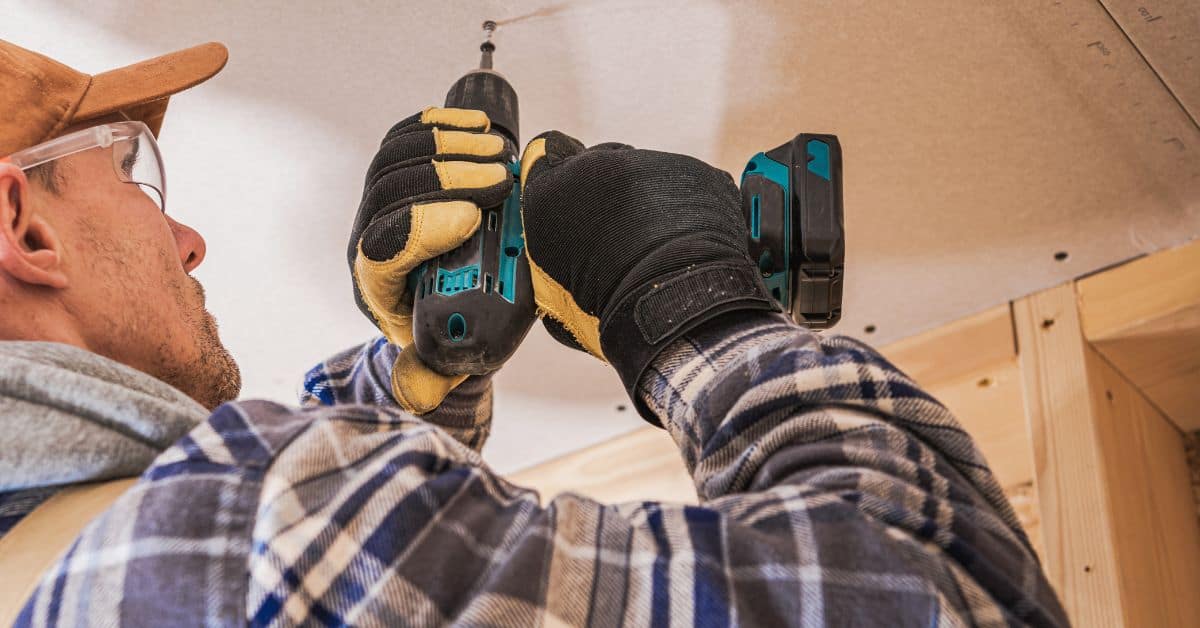
Temporary T-braces, cross-braces, and screw-in blocking can hold panels in position while you set fasteners; install them so they transfer load to solid framing and won’t shift during access. Put bracing in locations that are easy to remove once the panel is fully fastened, and mark removal order to avoid accidentally dislodging a panel.
Confirm acceptable bracing methods with the drywall manufacturer’s instructions or local code before relying on a particular system, especially if you alter framing or use nonstandard fasteners. If the acceptable attachment detail isn’t clear, check the product data sheet or ask the manufacturer.
Quick T-brace builds with lumber and screws
T-braces are quick, easy, and effective temporary supports for ceiling panels. Here’s how to build one:
1. Cut two 2x4s to the desired length, usually spanning joist centers (16″ or 24″).
2. Screw them together at a right angle using 3″ screws, spacing them every 8-10 inches along the length.
3. Place the T-brace between the wall and ceiling panel, straddling joists if possible. Inspect for proper fit and holding strength before hanging panels.
Ceiling wire, straps, and clamp bracing options
Wire, straps, and clamps offer adjustable support for ceiling panels. Here’s how to use them:
Wires: Use ratchet ties or wire rope clamps. Ensure they’re rated for the load (usually 50-100 lbs). Tighten gently, allowing panel movement.
Straps and Clamps: Use adjustable metal straps or panel clamps. Check connectors are secure and rated for the load. Adjust length to support panels without restricting movement.
Always inspect hardware before use, and remove supports once panels are securely fastened.
Safer Cutting Sequences and Panel Handling During Installs
Sequence cuts so large openings and complicated holes are made on the floor rather than overhead: transfer outlines to the panel on the floor, cut cleanly, and label cutouts for reinstallation before you lift. Keep cut pieces secured and transported in a balanced way to avoid dropping irregular shapes during the lift.
For any material-specific cutting guidance, consult the drywall manufacturer’s instructions and the cutting tool’s safety manual rather than assuming a method. If you’re unsure about a cut near a mechanical opening, verify clearances and mounting details first.
Marking and cutting openings on the floor first
Before you start lifting panels, do all your marking and rough-cutting while they’re still on the ground. This way, you minimize errors and reduce the risk of dropping pieces.
Use a straight edge and utility knife to score the panel lines. Then, use a drywall saw or reciprocating saw to cut out the openings. Keep it simple, keep it safe.
Pro tip: Always double-check your measurements before cutting. A little extra time on the ground saves a lot of hassle overhead.
Edge trimming and final fit adjustments after partial fasten
When you’re ready to install a panel, start by driving in just a few screws – leave the edges loose for now. This gives you room to make micro-adjustments later.
After the initial screws are in, do your final edge trimming. Use a utility knife and straight edge to trim any excess material. Be careful not to cut too deep and damage the drywall below.
Once trimmed, push the panel tight against the ceiling and complete the fastening sequence. This ensures a flush, even fit with no gaps or bulges. Remember: Less is more when it comes to final adjustments. A little at a time keeps your panels straight and true.
Fastening Strategy, Spacing, and Screw Sequencing
Start by tacking the panel at one edge and at the center to hold it while you install a progressive pattern of screws moving outward to prevent sag between framing members. Use a consistent screw pattern and back off slightly from screws near seams until the adjacent panel is in place to reduce panel edge crush and misalignment.
Follow the drywall manufacturer’s guidance for screw type, spacing, and allowed drive depth rather than guessing values. If the required spacing or fastener depth is not on the label, check the product data sheet or local code requirements before finalizing your pattern.
Initial tether points and progressive fastening order
Start by installing a few screws along the panel’s edges. These are your initial tether points, keeping the panel from sagging or shifting.
Next, work in stages across the panel. Fasten every 6-8 inches along the framing members first. Then, fill in the gaps between these anchor points with screws spaced about 12 inches apart.
Why this order? It maintains the panel’s geometry and prevents warping or buckling as you progress.
Dealing with awkward seams and butt joints
When a seam falls between framing members, it can be tricky to get a solid screw hold. Here’s how to tackle this:
First, use a shim or two at the seam to create a solid backing for your screws. Alternatively, you could add a small piece of blocking.
If that’s not enough, consider using construction adhesive along the seam before installing the panel. This adds extra hold and prevents squeaks down the road.
Finishing, Inspection, and Common Troubleshooting
After panels are fully fastened, inspect for proper screw depth, flushness at joints, and any gaps at edges that need shimming or additional blocking before taping and mudding. Note common issues—screw pops, sagging edges, misaligned sheets—and address them with targeted fixes like additional fasteners, shims, or re-cuts prior to finishing.
Confirm any finishing material recommendations and drying expectations with the compound manufacturer’s instructions and local finishing practices rather than assuming one approach fits all conditions. If a repair method is unfamiliar, check product literature or consult a pro for the safest repair sequence.
Visual checkpoints before mudding
Before you start taping and joint compounding, ensure your ceiling is ready for the next step. Here’s a quick checklist to run through.
- Check flatness: Walk around the room, look up, and check for any wavy or sagging panels. Inconsistencies could lead to visible imperfections in your finished ceiling.
- Inspect screw countersink: Ensure all screws are fully countersunk into the drywall. Protruding screws can cause bumps under the joint compound, leading to a rough finish.
- Check seam support: Gently press along seams and butt joints. If they feel spongy or give way, you may need additional support like tape or mesh before mudding.
Quick rule: A thorough visual check now saves time and effort later.
Fixes for common issues (sags, cracks, miscuts)
Don’t let minor issues turn into major setbacks. Here are some quick fixes for common ceiling drywall problems.
- Sagging panels: If a panel sags after installation, it might not have been properly supported or braced. Reinforce with temporary bracing and consider adding blocking for extra support.
- Cracked tape: Inspect taped seams and butt joints. If you find cracks, sand the area lightly, reapply joint compound, and retape before it dries out completely.
- Miscut openings: For miscuts around lights or vents, use a utility knife to trim away excess drywall. Then, apply a thin layer of joint compound, embed the paper tape, and let it dry before sanding.
Quick rule: Address these issues promptly to maintain a smooth, professional-looking ceiling finish.
Conclusion
You can finish a ceiling without a lift, but it requires solid plan and careful handling. The payoff is a sturdy, clean look that holds up over time if you stay focused on safety and steady progress.
Check your prep and workflow in sequence: verify panel layout and line up a clear path for each panel, secure temporary bracing before you lift, control panels with a helper or steady technique, set fasteners and spacing as you go, finish edges and seams, then inspect as you complete each phase. Move methodically and test a small area first to confirm balance, cutting accuracy, and screw driving without stripping or misaligning pieces.
Common mistakes to avoid: rushing panels into place without bracing, starting cuts without confirming layout, and skimping on screw spacing or proper sequencing near edges. Always wear eye and hearing protection, double-check for clearance above the drywall, and test panel fit in a dry run before committing fasteners. If anything feels unstable or requires more than one person for safe handling, pause and reassess rather than forcing it.
If the space or panel size pushes your comfort edge, call a pro before you risk damage to joists, drywall, or your ceiling line. Stay disciplined, keep safety first, and you’ll have a solid ceiling without a costly lift-assisted misstep. You’ve got this—one measured move at a time.
FAQ
1. How can I safely position drywall panels without a lift?
Work from a stable surface and use a clean staging area. Get a helper if possible, or use simple levers and supports to control the panel edge as you bring it to place. Check the manufacturer instructions for any weight limits or handling notes on the panels you’re using.
2. What temporary bracing methods work best for a ceiling install?
Install blocking and brackets to hold the panel edge while you fasten. Use adjustable supports or a couple of saw-horse style platforms to keep the panel from tilting. If unsure about spacing, refer to the panel label or manufacturer guidance for bracing intervals.
3. What’s the safest cutting sequence for ceiling drywall when you’re solo?
Cut panels on a stable surface first, then dry-fit before lifting any edge. Score and snap or use a utility knife followed by a clean break, keeping fingers clear of the cut line. Always wear eye protection and check the panel for any hidden wiring or HVAC before cutting.
4. How do I prevent panels from sagging before they’re fully fastened?
Hold the panel tight along the joint as you drive screws and use temporary supports at the mid-span if needed. Start fastening from the center and work outward to minimize movement. If you hear creaking or see deflection, pause and re-seat before driving more fasteners; consult label directions if deflection limits are listed.