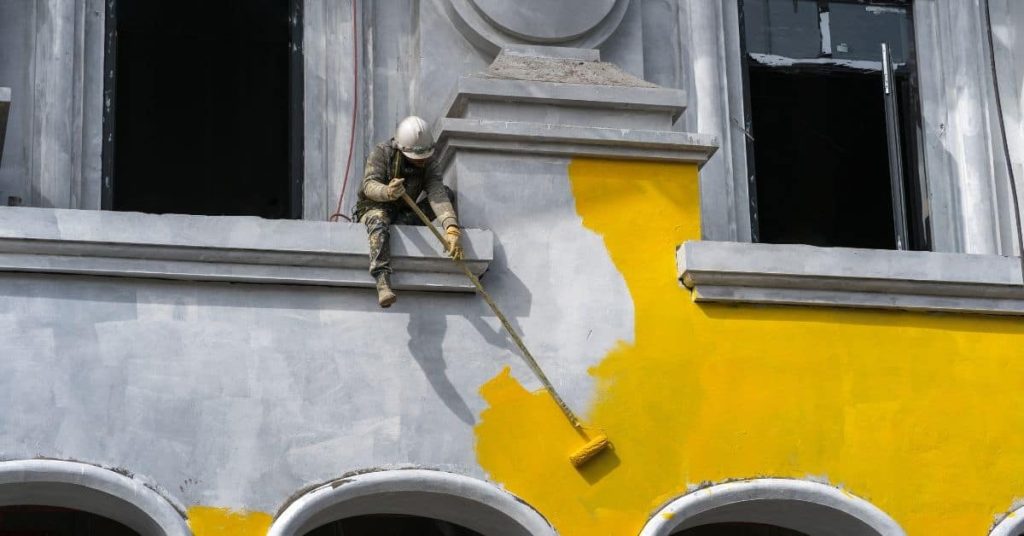
Worker wearing helmet painting exterior building yellow

Exterior Painting Timeline: Step-by-Step Guide to Avoid Overnight Blistering

Introduction

Planning your exterior painting project involves more than just choosing colors and brushes. Understanding the timeline is crucial to prevent blistering overnight, especially when dealing with dew point.

This step-by-step guide walks you through the process, from surface preparation to final touch-ups, ensuring you stay on schedule and avoid moisture-related issues.


The Exterior Painting Timeline: Step-by-Step

Follow this timeline to ensure your exterior painting project goes smoothly and stays within a reasonable timeframe:

  • Day 1-3: Surface Preparation – Clean, scrape, sand, and prime surfaces. Allow drying time between steps.
  • Day 4: Painting (First Coat) – Apply the first coat of paint, ensuring surface temperature is at least 5°F above dew point to prevent condensation.
  • Day 5-6: Drying and Touch-ups – Allow drying time (usually 24 hours) before applying a second coat. Perform touch-ups as needed.
  • Day 7: Painting (Second Coat) – Apply the final coat, following the same temperature guidelines as the first coat.
  • Day 8-10: Final Inspection and Clean-up – Inspect your work for any missed spots or imperfections. Clean up tools and materials.

Key takeaways

Proper timing is essential in exterior painting, especially when considering dew point. Allowing adequate drying time between coats and during surface preparation helps prevent moisture from becoming trapped under the paint, leading to blistering overnight.

  • Always compare surface temperature to air temperature before painting to plan timing.
  • Monitor dew point relative to surface to avoid condensation and blistering overnight.
  • RH affects cure speed; higher humidity slows drying and raises risk of moisture traps.
  • Use safe routines: check weather windows, surface prep, and avoid painting in freezing or wet conditions.
  • Tool checklist: infrared thermometer, hygrometer, and dew point charts; calibrate before use.
  • Substrate specifics matter: wood, metal, masonry, and fiber cement respond differently to moisture.
Table of Contents

What Is Dew Point and Why It Matters for Exterior Painting

Dew point is the temperature at which water vapor in the air begins to condense into liquid on a cooler surface. In plain terms: warm air can hold more moisture, and when that moist air contacts a surface that is at or below the dew point, visible or hidden moisture forms and can interfere with paint film formation.

Condensation during or after paint application causes blistering, loss of adhesion, and cosmetic failure on exterior substrates like wood, masonry, and siding. Before you start, check surface and ambient temperatures, surface moisture readings, and the forecast for temperature swings; use a dew point or hygrometer reading plus surface checks to decide whether to postpone, allow extra drying, or select products and film-build strategies that tolerate marginal conditions.

Dew point vs relative humidity

Dew point and relative humidity (RH) are both measures of moisture in the air, but they’re not the same thing.

Dew point is the temperature at which the air becomes saturated with water vapor. It’s like the tipping point for condensation.

Relative humidity, on the other hand, tells you what percentage of moisture the air is holding compared to its maximum capacity at a given temperature.

How dew forms on surfaces

Dew doesn’t just appear out of nowhere. It’s formed when warm, moist air comes into contact with a cooler surface.

The cooler surface can’t hold as much moisture as the warmer air, so some of that excess moisture condenses onto it, forming dew. This is why you often see dew on grass in the morning – the ground cools overnight and the air above it can’t hold all its moisture.

Think of it like this: imagine warm, moist air is like a sponge full of water. When that sponge touches a cool surface, some of that water has to come out to balance things out. That’s dew.

Back to top ↑

Surface and Air Temperatures: the Two Temps You Must Check

Air temperature and surface temperature both control condensation risk because the surface is what the paint actually touches. Surfaces can be warmer or cooler than the surrounding air due to sun exposure, thermal mass, shading, or overnight radiational cooling, so don’t assume air = surface.

Measure air temp with a shaded thermometer or hygrometer and surface temp with an infrared or contact thermometer, and check surface moisture likelihood with a moisture meter or simple touch tests. If the surface temperature is near or below the dew point, or within a few degrees of it, pause and reschedule; monitor forecasted lows and avoid painting in dawn/dusk windows when surfaces can cool quickly.

Measuring surface temperature (tools and best practice)

To accurately assess condensation risk, you need to measure the surface temperature of your exterior walls. Here are some tools and tips for spot checks:

  • Infrared Thermometer: Non-contact, easy to use. Key spec: -4°F to 572°F range. Tip: Point at dry, shaded areas.
  • Thermocouple: Contact probe for precise readings. Key spec: -200°F to 3996°F range. Warning: Can be pricey (~$100).
  • Multimeter with Temperature Probe: Versatile, affordable (~$20). Tip: Calibrate before use.
  • Laser Thermometer (optional): Non-contact, precise to 1°F. Warning: More expensive (~$50).
  • Rentable Tools: Consider renting for one-time projects. Prices vary by location.

Thermal behavior: daytime heating and nighttime cooling

Exterior surfaces go through daily temperature cycles that affect condensation risk. Here’s what happens:

Daytime Heating: Sunlight warms exterior walls, especially dark or light-colored surfaces. This heat can be significantly higher than the surrounding air, creating a temperature differential.

Nighttime Cooling: Once the sun sets, these surfaces start to radiate their stored heat back into the atmosphere. As they cool faster than the air, they reach dew point temperature and condensation forms – overnight blistering risk.

Understanding this thermal behavior helps you plan painting jobs around these daily cycles, minimizing condensation risks.

Back to top ↑

Relative Humidity and Its Impact on Drying and Cure

Relative humidity slows solvent and water evaporation from fresh paint, extending open time and the wet phase of the film. Higher RH can keep the film tacky longer, delay cure and hardness development, and increase the chance that moisture becomes trapped beneath the drying film.

Always check RH before and during exterior work with a reliable hygrometer or combined instrument that reports dew point as well. Use RH readings together with temperature and substrate moisture to decide whether to proceed, delay, or allow extra drying/recoat time; when RH is elevated, expect longer tack times and a higher blister risk, so follow product guidance and consider waiting for lower-humidity windows.

Effect on waterborne vs solvent-borne coatings

High relative humidity (RH) slows down the drying process of exterior paints. But it affects different types of coatings differently.

Waterborne paints rely on evaporation to dry. High RH means there’s more moisture in the air, which slows this evaporation. Drying time can double or even triple when RH is high.

Solvent-borne paints also rely on evaporation, but they’re less affected by RH. That’s because solvents evaporate faster than water. But even solvent-based coatings can be slowed down by high RH, especially if the paint has a high solids content or is applied thickly.

Humidity thresholds and specification checks

Before you start painting, check your coating’s technical data sheet. It’ll tell you the allowable RH range for application. This is usually between 40-70% RH.

Local conditions can push RH outside these ranges. For instance, if it’s humid or raining, RH could be higher than 70%. Or if it’s very dry and windy, RH might drop below 40%.

Always consider local microclimates. Paint near bodies of water or in valleys can have higher RH. High altitudes often have lower RH.

If RH is outside the specified range, you might need to delay painting until conditions improve. Or you could use a different coating designed for those conditions.

Back to top ↑

Ts Minus Td (Delta): the Critical Separation to Avoid Condensation

Ts–Td is the difference between the surface temperature (Ts) and the air dew point (Td); a positive separation reduces the chance that moisture will condense on the surface during prep, application, and cure. Aim for a safe separation and verify it frequently—before washing, before coating, between coats, and during early cure—because conditions change with sun, shade, wind, and humidity shifts.

Measure Ts with an IR gun or contact probe and Td from a hygrometer or dew point meter, then log the delta at key points of the job. If the separation narrows or reverses, stop and take mitigation steps: delay work, raise surface temperature, improve ventilation, or wait for a drier window; keep a simple log and clear stop-work criteria so the team knows when the job is out of range.

Why a minimum delta prevents blistering

Keeping your surface temperature above the dew point is crucial to prevent moisture from forming under your drying paint film. This stops blisters from happening.

Here’s why: When the surface temp drops below the dew point, moisture in the air condenses on the cool surface. If this happens while painting, that moisture gets trapped under the wet paint and can’t escape. As a result, it forms blisters as the paint dries.

Key takeaway: To avoid blistering, keep your surface temp above the dew point during prep, application, and cure.

What safe separations to aim for and what to check

Before you start painting, use this checklist to ensure your surface temp is safely above the dew point.

  • Check coating specs: Look up the recommended Ts–Td separation in your paint’s spec sheet or contract. Aim for a small positive margin above the dew point.
  • Surface temperature: Use an IR gun or contact thermometer to measure surface temp (Ts).
  • Dew point: Measure dew point (Td) using a hygrometer with dew point readout, or calculate it from dry-bulb and wet-bulb temps.
  • Calculate Ts–Td: Subtract the dew point from the surface temp to find your delta.
  • Maintain separation: Keep Ts – Td above the recommended threshold throughout prep, application, and cure.
  • Monitor continuously: Check Ts and Td regularly, not just at startup. Conditions can change quickly.
  • Account for changes: Consider sun/shade, wind, and ambient humidity changes that affect Ts and Td.
  • Document readings: Keep a simple log of Ts, Td, and Ts–Td readings for reference and to communicate with your team.

Quick rule: If Ts – Td drops below the recommended threshold, pause work, re-check later, or take mitigation steps until conditions improve.

Back to top ↑

Person spray painting gray paint on white wooden siding

Simple Checks and Timing: Quick Routines That Stop Overnight Blistering

A short, repeatable pre-paint and end-of-day routine will catch most dew risks that lead to overnight blistering. Focus on surface and air temperatures versus the forecast dew point, check for surface dampness, and confirm that the substrate is dry and above the minimum temperature recommended by the coating manufacturer.

Before you leave each day, run a quick dew-risk check: inspect surfaces for dampness, note expected overnight lows and humidity, and secure materials to limit moisture pickup. Use simple field tests (touch, breath-on, or an overnight plastic bag test) when you don’t have instruments, and build a dew-risk clock into scheduling so crews avoid beginning a job that will cool into condensation overnight.

Quick pre-paint checklist (visual and touch tests)

Before you start painting, run through this quick checklist to ensure your surfaces are ready. This helps prevent blistering caused by dew or moisture.

  • Check for visible moisture: Look for any signs of water on the surface. If present, wait until it’s completely dry.
  • Feel the surface: Touch the area you’re about to paint. If it feels damp or cool to the touch, it might still be wet from dew or condensation. Wait until it’s dry.
  • Inspect shaded areas: Check surfaces in the shade. They can stay cooler and hold moisture longer than sunny spots.
  • Confirm surface temperature: Use an infrared thermometer to ensure the surface is above the current dew point (see our earlier guide on measuring surface temp).
  • Avoid painting after rain: Wait until the surface is completely dry before starting. Painting on a wet surface can trap moisture and cause blistering.
  • Check forecast for dew or rain: If there’s a risk of dew or rain, postpone your work until conditions improve.
  • Ensure surfaces are dry: Even if it looks dry, use a moisture meter to confirm. Painting over damp surfaces can lead to blistering.
  • Verify substrate temperature: Make sure the minimum substrate temp (Ts) is above the current dew point (Td). This prevents condensation and blistering.

Quick rule: If in doubt, wait. Painting over damp or moist surfaces can cause blisters to form overnight.

Best times of day and short project scheduling

The time of day you start and finish painting can impact the performance of your exterior paint. Here are some guidelines to help you schedule your work.

Start after dew burns off: Begin painting in the morning, once the dew has evaporated. This ensures your surfaces are dry and ready for paint.

Avoid late afternoon finishes: Try not to leave freshly painted surfaces exposed overnight. Humidity levels can rise in the evening, leading to condensation and blistering.

Plan coats wisely: Schedule your painting so that the initial set occurs before evening humidity rises. This helps prevent moisture from being trapped under the paint film.

Consider drying times: Allow enough time for each coat to dry completely before applying the next one. This prevents trapping moisture and reduces the risk of blistering.

Back to top ↑

Tools and Materials Checklist: Instruments, Use, and Maintenance

Carry a short kit: a shaded air thermometer or hygrometer, an infrared surface thermometer, a basic moisture meter, and a notebook or phone log for readings. Categorize items into affordable tools for DIYers and higher-accuracy instruments for pro work, and verify each tool’s instructions or calibration recommendations before relying on results.

Record readings at start-of-day, pre-application, between coats, and at the end of day so you can track trends and spot changing conditions. Keep spare batteries, a soft cloth for lens/probe cleaning, and a simple verification routine (known-temperature check or cross-check against a trusted device) so instruments stay reliable on the job.

Key instruments and what they tell you

Before you start painting, check these tools to ensure a successful job.

  • Psychrometer or Assisted Wet-Bulb Tool: Measures relative humidity. Essential for checking if conditions are too humid for exterior painting.
  • Digital Dew Point Meter: Measures dew point temperature. Helps prevent blistering by showing when condensation is likely to form.
  • IR Thermometer: Measures surface temperature. Crucial for ensuring the substrate isn’t too cold for paint application.
  • Moisture Meter: Checks substrate moisture content. Vital for preventing adhesion issues and blistering.

Quick rule: Use these tools to ensure your painting conditions are optimal, preventing costly rework and blistering.

How to use, calibrate, and record readings

Regularly take readings throughout your project to maintain quality control.

  • Morning: Start of Day: Take initial readings to set a baseline for the day.
  • Mid-Morning: Recheck conditions after the surface has heated up.
  • Pre-Application: Confirm conditions are suitable before painting.
  • Post-Application: Verify no condensation is forming on the wet paint.
  • Daily End: Before Leaving Site: Take final readings to track changes throughout the day.
  • Calibrate Tools: Regularly check and calibrate tools using known standards or manufacturer’s instructions.

Quick rule: Consistently monitor conditions and maintain your tools to ensure accurate readings and a successful paint job.

Back to top ↑

Substrate-Specific Considerations: Wood, Metal, Masonry, and Fiber Cement

Different materials absorb and release heat and moisture differently, which changes their exposure to dew point conditions. For example, thin siding heats and cools quickly, dense masonry holds thermal mass, and metal can drop below air temperature rapidly; those behaviors affect condensation risk and dictate different prep and priming approaches.

Measure moisture content and surface temperature on each substrate type at relevant times of day and follow manufacturer guidance for acceptable moisture levels and drying windows. Tailor priming and sealing strategies to reduce moisture transfer—use the recommended primers and allow extra open time or drying when humidity or thermal conditions are marginal—and time work so critical drying and cure periods avoid forecasted dew or wetting events.

Wood and fiber cement

Wood and fiber cement substrates behave differently when it comes to heat and moisture absorption. Here’s what you need to know:

Wood: End grain holds moisture longer, and horizontal surfaces can stay damp. Ensure full drying before painting.

Fiber Cement: It absorbs less moisture than wood but still needs proper drying and priming. Use a primer that seals the substrate and controls porosity.

Metal and masonry

Metal and masonry substrates require specific attention to prevent condensation:

Metal: It cools quickly, raising condensation risk. Ensure a safe Ts-Td separation before painting.

Masonry: It can hold moisture, so check surface dryness with an IR thermometer and hygrometer. Allow adequate drying/curing time.

Back to top ↑

Common Mistakes, Safety Precautions, and Cost of Rework

Frequent errors include ignoring Ts–Td, relying on a single reading, or misreading instruments—any of which can let a job proceed under risky condensation conditions. Take multiple readings over the work period, verify instrument calibration or cross-check with a second tool, and place probes correctly on the surface to avoid bad data driving a bad decision.

For safety, use proper PPE, secure ladders on dry surfaces, and avoid electrical work near wet substrates; stop work if weather turns severe. If blistering occurs and repainting is required, expect added prep, wasted material, lost labor time, and possible warranty issues—document readings and decisions as you go to reduce disputes and to justify schedule or cost changes.

Top mistakes in interpreting dew point data

To avoid blistering, it’s crucial to interpret dew point data correctly. Here are common pitfalls to steer clear of:

  • Mixing up relative humidity (RH) and dew point: RH tells you how much moisture is in the air, while dew point indicates when that moisture will condense into liquid. Always check both.
  • Not measuring surface temperature: Just knowing the ambient dew point isn’t enough. Measure your substrate’s temperature too.
  • Assuming conditions are uniform across the project: Dew points and temperatures can vary from one side of a building to another. Always check multiple spots.
  • Relying on a single reading: Conditions change throughout the day. Take readings at different times to get a better picture.

By avoiding these mistakes, you’ll have a clearer understanding of your project’s dew point situation.

Safety and risk mitigation when measuring and painting

Your safety is paramount. Here are some key precautions to take:

Electrical hazards: Keep a safe distance from electrical sources, especially in wet conditions.

Safe access: Use stable ladders or platforms when measuring high surfaces. Never climb on unstable structures.

Protect workers: Ensure your team is protected from exposure to solvents and cold temperatures. Always wear appropriate PPE, including gloves and eye protection.

Cost implications and when to call a pro

Improper environmental monitoring can lead to costly rework. Here’s what you need to know:

Rework costs include labor, materials, additional prep time, and potential permit or warranty issues.

When to call a professional: If you’re seeing recurring blistering, inconsistent readings, or working on large high-value surfaces, consider hiring an expert. They have specialized equipment and training to handle complex dew point situations.

While DIY is great for simple projects, some jobs require professional intervention to avoid costly mistakes.

Back to top ↑

Conclusion

Getting the weather and surface conditions right is your best defense against blistering and rework. If you protect against condensation and keep temperatures and humidity in check, your paint will cure properly and look solid for years. This is about practical checks you can do before you roll or spray.

Check the conditions in plain language: verify the surface and air temperatures are higher than the dew point by a safe margin, confirm relative humidity is not at a level that slows drying, and make sure Ts minus Td stays positive enough to avoid overnight condensation. Do a quick routine: measure with the tools you already have, compare readings to the paint’s dry- and cure-time guidance, and delay or adjust your plan if any number is in the red zone. Start with a small test area if you’re unsure, and document the results for the next coat.

Common mistakes to avoid include chasing a perfect temperature window at the expense of safety, skipping the dew point check on damp mornings, and mixing or applying when surfaces are cooler than the surrounding air. Safety rules: always wear eye protection and gloves, ventilate if indoors, and never apply paint over wet or frosted surfaces. If you’re unsure about the substrate or the forecast, err on the side of delaying the project and consult a pro before you risk costly damage.

If the conditions keep shifting or you’re dealing with tricky substrates like warped wood, corroded metal, or porous masonry, it makes sense to call in a professional rather than push ahead. Stay disciplined, document your checks, and keep your project moving only when the odds are in your favor. Stay steady, stay safe, and you’ll finish with a durable, good-looking coat.

Back to top ↑

FAQ

Why should I measure environmental conditions for coatings and paints?

Coatings don’t dry or cure the same in every day. Temperature, humidity, and dew point drive drying speed and the risk of defects like blisters. Use a reliable tool, record the readings, and check the product instructions for their min/max conditions.

How does surface temperature relate to air temperature, and why do I need to measure it too?

The surface can be warmer or cooler than the air, and that gap changes when and how the coating cures. Measure both surface and air temps if you can, and follow the product’s guidance on acceptable surface temps for application.

How does relative humidity affect curing time, and why isn’t air temperature enough?

High humidity slows evaporation and can extend cure times; low humidity speeds drying but may cause other issues. Don’t rely on air temp alone—check RH and compare it to the coating’s instructions to estimate safe work windows.

What is dew point, and why is Ts–Td (Delta) important for exterior coatings?

Dew point is the temperature at which air moisture begins to condense on a surface. A small Ts–Td delta means more risk of condensation on the substrate; keep an eye on both surface temp and dew point, especially overnight. Use the product’s recommended delta thresholds if provided, or check manufacturer guidance.

What instruments should I use to measure dew point and environmental conditions, and how should I use them?

Use a digital hygrometer with dew point display or a combined environmental meter. For best results, take readings at the work surface or just above it and log them with time. Always verify the instrument’s label, datasheet, or manufacturer instructions for accuracy and calibration intervals. If in doubt, compare readings against local rules or product guidance.

Back to top ↑