
Introduction
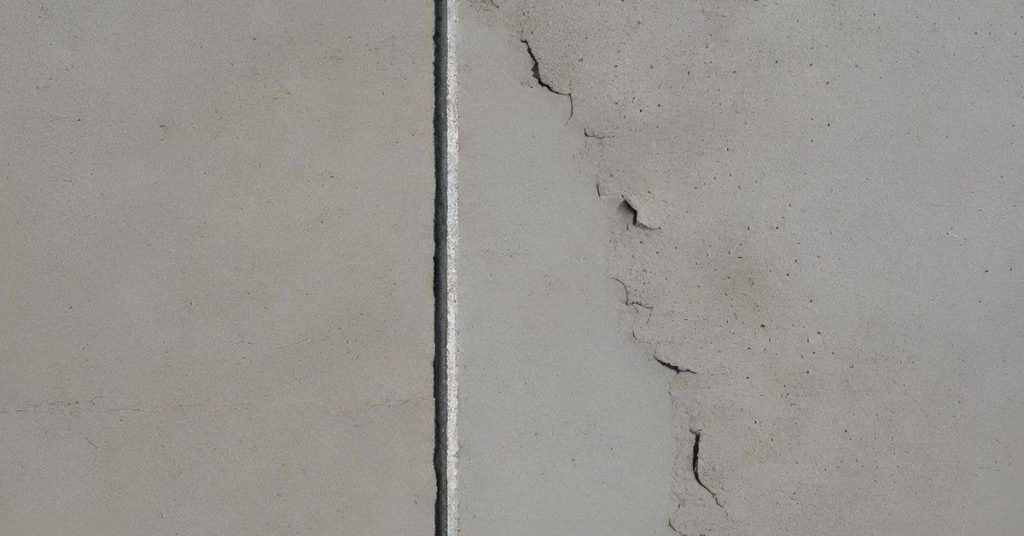
Suspected alkali-silica reaction (ASR) is not a DIY crack-repair diagnosis. Map cracking, dampness, gel-like deposits, spalling, or displaced joints can suggest ASR, but freeze–thaw damage, drying shrinkage, reinforcement corrosion, settlement, and structural movement can look similar—and can occur at the same time. Before approving an ASR-specific repair, document the distress, rule out urgent structural hazards, and obtain core petrography and laboratory review.
Monitoring can be reasonable when the structure is stable, accessible, and covered by an engineer-reviewed inspection plan. Repair may be practical when deterioration is localized and the remaining concrete is sound. Surface treatments, crack repair, overlays, and patches can serve specific purposes, but none automatically stops internal ASR. Replacement becomes more likely when expansion, internal cracking, reinforcement problems, distortion, or loss of capacity is widespread or continuing.
Key takeaways
- ASR needs susceptible aggregate, sufficiently alkaline pore solution, and available moisture; temperature affects its rate, but no simple visual or temperature rule confirms it.
- Map cracking alone is not proof. Confirmed field diagnosis normally combines a condition survey, cores, and petrographic examination.
- Do not use ASTM C1260 or C1293 as standalone tests to diagnose cracking in an existing member; they evaluate aggregate or mixture expansion potential.
- Sealers, injections, overlays, and patches may reduce selected moisture paths or restore local function, but they do not remove reactive aggregate or internal alkalis.
- Structural members, active movement, significant spalls, exposed reinforcement, distortion, and uncertain capacity require a qualified engineer rather than unsupervised repair.
Table of Contents
- Introduction
- Key takeaways
- What Is ASR? History and Mechanism
- Identifying ASR: Visual Signs and Diagnostic Testing
- ASR Prognosis and Monitoring
- Mitigation Strategies for New Concrete (Prevention in Design and Construction)
- Treatment Options for Existing ASR-Affected Structures
- Economics, Cost-Benefit Analysis, and When to Consider Replacement
- Practical Guidance, Common Mistakes, Safety, and Case Studies
- Conclusion
- FAQ
What Is ASR? History and Mechanism
ASR is a chemical reaction in concrete between reactive forms of silica in aggregate and alkalis in the cement paste. In the presence of sufficient moisture, reaction products can absorb water, expand, and crack the surrounding concrete. The rate and severity depend on aggregate mineralogy, available alkalis, moisture, temperature, time, and the concrete’s transport and exposure conditions.
Historical discovery and prevalence
Concrete failures in California in the late 1930s led to the recognition of ASR; Stanton’s 1940 work is commonly cited as its first formal identification. Subsequent research clarified reactive aggregate constituents, reaction products, and the conditions that influence expansion. ASR can occur wherever susceptible aggregate and suitable concrete and exposure conditions coincide.
Chemical mechanism and susceptible aggregates
The reaction may form products around or within susceptible aggregate particles. When enough moisture is available, expansion can create internal microcracking, map cracking, displacement, and reduced durability. Some forms of silica are more susceptible than others, but identifying a visible aggregate as reactive is not reliable field confirmation.
Do not use an undefined “alkalinity” threshold, a crack pattern, or weather alone to diagnose ASR. The Federal Highway Administration notes that visual indicators are useful for identifying suspect concrete, but confirmation requires laboratory testing and petrographic examination of cores. FHWA’s visual guide to identifying ASR also emphasizes that ASR may coexist with other deterioration mechanisms.
Identifying ASR: Visual Signs and Diagnostic Testing
Start with triage, not treatment. Map the crack pattern and record crack width, length, orientation, staining or deposits, damp areas, spalls, popouts, closed joints, displacement, and changes since earlier inspections. Photograph each location with a scale and identify the member, exposure, and date.
Visual checkpoints and inspection checklist
Use the walk-down to identify possible causes and to decide whether the area needs urgent engineering review.
- Possible ASR: Map or interconnected cracking, damp exposure, deposits or efflorescence, expansion-related movement, and later petrographic evidence of reaction products and reactive aggregate.
- Possible freeze–thaw damage: Scaling, surface deterioration, popouts, or paste and aggregate damage in saturated freeze–thaw exposure.
- Possible shrinkage: Cracking associated with early-age restraint or surface moisture loss; a map pattern alone is not diagnostic.
- Possible corrosion: Cracks generally following reinforcement, rust staining, delamination, and spalling.
- Possible settlement or structural movement: Localized diagonal, vertical, or differential cracks with distortion, support movement, or foundation concerns.
- Escalate immediately: Misalignment, excessive deflection, joint closure, unstable spalls, exposed or corroding reinforcement, loss of section, or cracking in a primary load-carrying member.
Field documentation and sampling
Field observations identify where to investigate; they do not establish the cause. Record moisture and drainage history, deicing-salt exposure, known repairs, concrete age, member type, loading, and access limitations. Do not chip or core structural concrete without a sampling plan and authorization from the responsible engineer.
A useful laboratory package includes the condition survey, photographs, climate and moisture information, core locations and orientations, the reason for each sample, and notes on cracks, reinforcement, deposits, and visibly different concrete. Cores from both distressed and apparently sound areas may be needed to establish the extent of damage.
Laboratory diagnosis and petrographic analysis
Petrographic examination of cores can identify reaction products, affected aggregate, internal cracking, and competing deterioration. Supporting mechanical, chemical, or microscopy work may be specified when it will affect the structural assessment or repair choice.
ASTM C1260 and C1293 are not generic confirmation tests for a cracked structure. C1260 is an accelerated mortar-bar screening method; C1293 measures length change in concrete prisms to evaluate aggregate or aggregate–cementitious-material combinations. Neither test alone proves that existing cracks are caused by ASR, establishes current field expansion, or determines member capacity. The ASTM C1293 standard test description notes that petrographic examination follows testing to confirm reactive constituents and reaction products.
ASR Prognosis and Monitoring
Monitoring is condition management, not a substitute for a structural-safety evaluation. It may be appropriate when no evidence indicates immediate instability, the locations can be accessed safely, and an engineer has set the method, review interval, and escalation triggers.
Establishing baseline condition and monitoring plans
Establish a baseline with dated crack maps, photographs, measured reference points for dimensional change where expansion is a concern, and records of moisture, drainage, temperature, and loading conditions. Use consistent locations, tools, and measurement methods. Review intervals should fit the structure and observed change; they must capture seasonal variation rather than follow a universal three-, six-, or twelve-month schedule.
Rebound-hammer and ultrasonic readings can supplement a broader condition survey, but moisture, surface condition, aggregate, geometry, cracking, temperature, and test setup affect results. They do not independently diagnose ASR or quantify its progression.
Interpreting monitoring data for decision-making
Compare repeated readings at the same reference points and conditions. Avoid assigning a reaction stage from crack width alone: opening and closure can reflect temperature, moisture, restraint, corrosion, freeze–thaw effects, and measurement location as well as ASR. An engineer should review trends alongside petrography, exposure, member function, reinforcement condition, and structural demand.
Seek prompt reassessment if measured expansion continues, cracks or joints change materially, spalls develop, water pathways worsen, reinforcement becomes exposed, or distortion affects operation or safety. Monitoring may need to continue after repair to show whether the selected treatment is performing as intended.
Mitigation Strategies for New Concrete (Prevention in Design and Construction)
Prevention for replacement work or new concrete starts with a qualified mix design, aggregate-reactivity evaluation, alkali control, and moisture-management details. The selected system must be evaluated for the actual aggregate source, cementitious materials, exposure, and specified service life.
Use of SCMs, low-alkali cement, and other admixtures
Supplementary cementitious materials such as fly ash or slag, low-alkali cement, and other qualified mitigation systems can reduce ASR risk when selected and proportioned for the project. Silica fume and lithium admixtures may also be considered in a project-specific design. Do not assume that one material or dosage works for every aggregate combination.
Lithium admixtures and comparative considerations
Lithium compounds used as admixtures are distinct from treatment of hardened, ASR-affected concrete. Compare a lithium admixture with SCM-based mitigation through project testing, specifications, availability, cost, and expected exposure. A materials engineer should confirm compatibility before use.
Construction practices and QA to prevent ASR
Verify aggregate sources and approved mix documentation before placement. Control specified slump, air content, temperature, curing, joints, drainage, and water exposure. Proper curing helps limit shrinkage and premature drying; it does not replace aggregate and mixture qualification. Keep records of approved materials, batch data, test results, and mitigation decisions for future maintenance. Related guidance: Concrete Air Content Testing for DIYers: Simple Field Checks and What to Do When It’s Off.
Treatment Options for Existing ASR-Affected Structures
Select treatment only after diagnosis, prognosis, and structural evaluation. The choice depends on structure type, extent of internal cracking, permeability, moisture exposure, crack movement, reinforcement condition, access, drainage, substrate quality, and the performance required. A repair should have a stated purpose—such as restoring cover, reducing a moisture pathway, sealing a dormant crack, or restoring capacity—and measurable acceptance criteria.
Lithium-based post-treatments: benefits and limits
Lithium treatment of existing concrete is specialized and project-specific. Field delivery and effectiveness depend on permeability, moisture condition, geometry, reaction stage, achievable penetration, dosage, and the delivery method. It does not reverse existing damage, and it should not be represented as a general way to arrest expansion, prevent new cracks, or stabilize a structure.
Do not treat crack injection as a generic lithium-delivery method. Any lithium proposal should include product documentation, substrate requirements, a project-specific application and verification plan, and post-treatment monitoring. Where capacity or public safety is involved, this work belongs under qualified engineering and specialty-contractor control.
Overlays, sealers, and localized repairs
Sealers and moisture-reduction treatments: A compatible system may reduce selected external moisture pathways. It does not remove reactive aggregate or internal alkalis, and it may be ineffective if cracks, joints, edges, drainage defects, or uncoated surfaces continue to admit water. Evaluate vapor and moisture behavior, bond, detailing, access, and maintenance.
Crack injection or sealing: Epoxy can restore continuity in selected dormant cracks when the substrate is sound and dry enough for the product. Flexible materials may seal selected moving cracks. Neither stops ASR. If expansion remains active, rigid repairs can crack again; sealing can also redirect or retain moisture if drainage and crack movement are not considered.
Overlays: An overlay can provide a new wearing or protective surface, but it does not generally arrest ASR inside the original concrete. Check substrate soundness, bond, expected movement, moisture transmission, drainage, reinforcement condition, and the risk of reflective cracking or debonding.
Localized removal and patching: Patches restore profile, cover, or locally damaged concrete. They are durable only when the remaining substrate is stable and the repair can accommodate expected movement. Patches can crack or debond if adjacent ASR-affected concrete continues to expand.
Structural strengthening and load-path repairs
Strengthening, reinforced overlays, external fiber-reinforced systems, load redistribution, shoring, or partial replacement can be considered only after an engineer evaluates capacity, stiffness, anchorage, reinforcement development, load paths, and the condition of the repair substrate. These are not cosmetic repairs and should not be designed from surface cracks alone.
Economics, Cost-Benefit Analysis, and When to Consider Replacement
Do not rely on a universal ASR repair price per square foot. Costs vary with access, traffic control or shutdowns, testing, moisture management, repair depth, reinforcement work, temporary support, replacement scope, and regional labor and material conditions. Compare alternatives over the required service period, including inspection, maintenance, risk, downtime, and the likelihood of repeated repair.
Direct and Indirect Cost Drivers
Include engineering and structural assessment; surveys and monitoring; cores and petrography; access and containment; drainage work; crack repair, sealing, overlays, or patching; reinforcement repair; removal and replacement; temporary support; curing and protection; and follow-up monitoring. A low first cost is not a value if the repair is incompatible with continuing movement or cannot deliver the required service life.
Decision Framework and Replacement Triggers
Partial repair or strengthening may be considered when deterioration is localized, the remaining concrete has adequate strength and bond, reinforcement is adequate or can be restored, the cause and extent are confirmed, and the repair can accommodate expected future movement.
Partial or full replacement becomes more realistic when expansion causes unacceptable distortion, poor fit, or serviceability problems; when capacity, stiffness, anchorage, or reinforcement development is materially compromised; when internal damage is widespread or inaccessible; when ASR remains active and the repair would be cosmetic; or when repeated repair and monitoring are less reliable than replacement over the required service life. These are engineering decision factors, not universal crack-width thresholds.
Obtain a written recommendation that states the diagnosis, extent, expected future expansion, structural implications, repair purpose and limitations, acceptance criteria, monitoring plan, and the reason replacement is or is not warranted.
Practical Guidance, Common Mistakes, Safety, and Case Studies
Use this order: document distress; control immediate hazards; investigate competing causes; obtain cores and petrography when ASR-specific action is proposed; establish prognosis and structural implications; select a compatible repair or replacement scope; verify the completed work; and monitor where continued movement is possible.
Common mistakes in diagnosis and mitigation
- Diagnosing from a crack pattern: Map cracking is suggestive, not conclusive. ASR can coexist with corrosion, freeze–thaw damage, shrinkage, or movement.
- Using C1260 or C1293 as field confirmation: These tests evaluate aggregate or mixture behavior, not the cause or capacity of an existing cracked member.
- Sealing active movement rigidly: A rigid crack repair can fail when expansion continues.
- Calling a surface treatment an ASR cure: Sealers and overlays may manage selected moisture paths but do not remove the internal reaction mechanism.
- Skipping monitoring and acceptance checks: A repair needs documented bond, cover, drainage, crack-sealing, curing, and dimensional or condition follow-up as applicable.
Safety considerations during inspection and treatment
- Stop and obtain engineering assessment before entering, loading, cutting, coring, or repairing a member with instability, substantial spalls, exposed reinforcement, distortion, or uncertain capacity.
- PPE: Use task-appropriate hard hats, safety glasses, gloves, protective footwear, and high-visibility clothing. Follow the product safety data for repair chemicals.
- Dust and debris: Use suitable containment and dust control during removal or drilling. Secure falling-concrete hazards before work begins.
- Access and utilities: Plan safe access, traffic or pedestrian control, and electrical isolation where required. Do not rely on damaged concrete for anchorage.
- Environmental and curing requirements: Check permits, waste handling, drainage protection, product temperature and moisture limits, curing requirements, and local code requirements before work.
- Professional limits: Coring, lithium treatment, overlays, strengthening, shoring, concrete removal, and any repair affecting structural capacity require qualified design and installation.
Information to obtain before authorizing repair or replacement
- A condition survey with mapped cracks, spalls, delaminations, damp areas, joint movement, distortion, and dated photographs.
- A differential diagnosis addressing ASR, freeze–thaw deterioration, corrosion, shrinkage, settlement, and construction defects.
- A core-sampling and laboratory scope identifying locations, orientation, depth, petrography, and any supporting testing.
- A prognosis for future expansion and a monitoring plan with reference locations, review intervals, and escalation triggers.
- A structural assessment covering capacity, stiffness, reinforcement, bond, anchorage, serviceability, and safety.
- For each alternative: purpose, limitations, access needs, drainage and moisture details, compatibility, acceptance criteria, maintenance, and expected service life.
Conclusion
Treat suspected ASR as an investigation and asset-management problem, not a surface-crack project. Document the distress, address immediate hazards, confirm the cause with appropriate sampling and petrography, then base monitoring, repair, strengthening, or replacement on expected movement and structural performance.
A repair can be appropriate for localized, stable, well-characterized deterioration. Replacement is more defensible when damage or continuing expansion undermines capacity, serviceability, fit, repair durability, or safety. If the concrete is structural, cracking is changing, or spalls and reinforcement are involved, pause the work and obtain a qualified engineer’s assessment.
FAQ
What is ASR?
ASR is a reaction between reactive silica in aggregate and alkalis in concrete. With sufficient moisture, reaction products can expand and crack the concrete. Susceptible aggregate, concrete chemistry, moisture, temperature, and time all influence whether and how quickly damage develops.
How is ASR diagnosed in an existing structure?
Start with a mapped condition survey and a review of moisture, drainage, loading, and repair history. Because similar cracking can result from corrosion, freeze–thaw damage, shrinkage, or movement, visual evidence is not enough. Confirmation normally requires engineer-directed cores and petrographic examination, with supporting tests as needed.
Can crack injection, sealer, or an overlay stop ASR?
No. These measures may seal selected cracks, restore local continuity, provide a new surface, or reduce some external moisture entry when properly designed. They do not remove reactive aggregate or internal alkalis. Active expansion can cause a rigid injection, patch, or overlay to crack or debond.
When is replacement preferable to repair?
Replacement is more likely when damage is widespread, continued expansion causes distortion or serviceability problems, reinforcement or anchorage is compromised, the remaining substrate cannot support a durable repair, or repeated repair and monitoring are less reliable than replacement. The decision requires structural and life-cycle evaluation, not a crack-width rule alone.