
Introduction
Re-entrant corners are sharp, inward-facing corners in a concrete layout where cracks tend to start. This article covers simple layout tricks to reduce those stress cracks during pouring and finishing. You’ll learn practical ideas you can apply on a DIY project without fancy tools.
Using radiused corners and properly placed joint lines helps lower stress at re-entrant spots and reduces the chance of shrinkage cracks. Be mindful of how the slab sits on soil, and plan for potential heaving or settlement by spacing joints and planning drainage accordingly. If you’re unsure about joint spacing or curing practices, check the product instructions and local rules for your area.
Key takeaways
- Plan chamfered or eased corners early to lower stress concentration and cracking risk.
- Include proper jointing and related detailing to manage shrinkage and movement.
- Use continuous reinforcement and clean joints to reduce crack propagation at re-entrant corners.
- Ensure formwork allows drainage and aligns to avoid trapping moisture that causes heave.
- Schedule pours to minimize cold joints and freeze-thaw damage; follow PPE guidelines.
- Inspect for shrinkage cracks and address early with control joints and sealants.
Table of Contents
- Introduction
- Key takeaways
- Why Re-Entrant Corners Concentrate Stress and Crack
- Types of Cracks You’ll See at Re-Entrant Corners
- Layout and Detailing Tricks to Reduce Stress at Corners
- Reinforcement, Joints, and Hardware Strategies
- Construction Best Practices to Prevent Corner Cracking
- Common Mistakes and How to Avoid Them
- Cost and Lifecycle Considerations: Prevention Vs Repair
- Tools, Materials, Specs, and Visual Checkpoints for Inspection
- Conclusion
- FAQ
Why Re-Entrant Corners Concentrate Stress and Crack
Concave corners trap and amplify stresses in ways that straight-line analysis can miss. Local geometry creates high-stress lobes where tensile forces concentrate as the concrete resists restraint from surrounding material and forms. As temperatures shift and concrete shrinks, restrained portions pull on the inner corner, setting up tensile zones even under overall compression.
Crack initiation and propagation follow these stress paths, with concave radii guiding crack trajectories. Material behavior such as aging, microcracking, and time-dependent creep further elevate long-term risk at re-entrant points. Look for signs of distress that reflect this interplay, and note how geometry and restraint together drive cracking risk, guiding how detailing decisions are approached without proposing full design solutions here.
Tension vs Compression Behavior of Concrete
Concrete’s strong suit is compression. It can take heavy loads when squeezed together. But put it under tension – pulling apart – and it’s weak.
Corners change the game. They turn compression into tension. Here’s how:
Concave corners create stress concentrations. Straight-line assumptions don’t work here. The geometry amplifies local stresses, turning some of that compression into tensile stress at the inner corner.
Role of Restraint, Shrinkage, and Thermal Movement
Concrete wants to shrink as it dries. But if it’s restrained – stuck between a slab or wall – it can’t. That creates tension.
Temperature changes add to the stress. Concrete expands when heated and contracts when cooled. If it can’t move freely, that also causes tension.
At corners, these tensions are amplified. The concave geometry focuses them at the inner corner, making cracks more likely.
Types of Cracks You’ll See at Re-Entrant Corners
Shrinkage cracks at re-entrant corners form as the concrete losses moisture and contracts at different rates than adjacent, restrained areas. Structural or load-induced cracks cut across corners when the member carries service loads and restraint dominates the internal stress paths. They often display characteristic directions that align with the corner geometry.
Settlement or heave can produce movement that reopens or propagates cracks near the corner, while freeze-thaw damage tends to appear where moisture exposure is high. Diagnostic cues include crack orientation, width changes over time, and moisture staining near joints or forms. For planning, verify form geometry, corner radii, joint layout, reinforcement details, curing methods, and soil conditions to minimize these stresses, and decide if remediation or design tweaks are needed when cracks behave beyond expected thresholds.
Shrinkage and Plastic-Shrinkage Cracks
Concrete shrinks as it dries, and corners are where this shrinkage is most noticeable. This happens because corners have less concrete to support the drying process.
Plastic-shrinkage cracks happen early, within a few hours or days of pouring. They’re fine, hairline cracks that form due to rapid moisture loss before the concrete has set fully.
Corners are hotspots for these cracks because they dry faster than other areas. To minimize them, keep corners moist and well-covered during the first few days after pouring.
Settlement, Heave, and Load-Related Cracks
Subgrade movement – settlement or heave – can cause cracks to start or worsen at corners. If the soil under your concrete settles or rises unevenly, it puts stress on the corners.
Differential loading – when one part of the slab bears more weight than another – can also create these cracks. Corners bear a lot of weight, so they’re vulnerable to this type of cracking.
To prevent these cracks, ensure your subgrade is well-compacted and stable. Use proper reinforcement and joint layout to distribute loads evenly.
Freeze-Thaw and Environmental Deterioration
Existing cracks at corners can widen and deepen due to freeze-thaw cycles. When water gets into these cracks, freezes, and expands, it forces the crack open wider.
Moisture ingress also weakens the concrete over time. This is why you see more deterioration in corners that are exposed to weather or have poor drainage.
To protect against this, seal existing cracks before winter. Ensure your corner details allow for proper drainage and keep moisture away from the concrete.
Layout and Detailing Tricks to Reduce Stress at Corners
Eliminate sharp internal angles by adding rounded fillets or chamfers at re-entrant corners to reduce stress concentration and slow crack initiation. Return details and alternating plan radii smooth the geometry and avoid fixed 90-degree confines whenever possible. This approach helps transfer stresses more evenly as concrete cures.
Strategic joint planning near corners, including control and isolation joints, with sensible spacing and timing, helps relieve tensile stresses during curing. Detail reinforcement to maintain continuity, with proper coverage and proper bar staggering. Improve formwork and edge detailing with adequate radii, gradual transitions, and careful compaction to prevent cold joints and micro-crack propagation at the corners.
Soften the corner: fillets, chamfers, and returns
Sharp corners in concrete are stress points. They can crack under pressure. Soften ’em up with these details:
Fillets: That’s a fancy word for a rounded corner. Check your project specs or common practice ranges, but aim for fillets between 1/4″ to 3/8″. Too small, and it won’t help much. Too big, and you’re wasting concrete.
Chamfers: These are beveled edges that slope from the top of the corner down to the wall face. They’re not as strong as fillets but still better than sharp corners. Check your local rules or manufacturer’s instructions for suitable angles and sizes.
Returns: These are small, rounded pieces of concrete that stick out from the wall face at the corner. They help distribute stress evenly. Again, check specs or common practice ranges for size, usually around 1/4″ to 3/8″.
Strategic placement of control and isolation joints
Corners are where concrete wants to crack. To stop this, you need to plan your saw cuts, control joints, and isolation joints right.
First, check local codes. They might have rules on joint spacing. Generally, aim for every 10-12 feet in both directions from corners.
Now, here’s how to place ’em:
Saw cuts: Run them diagonally across corners. This lets concrete shrink naturally without cracking at the corner itself.
Control joints: These should be straight and run perpendicular to the direction of slab movement. Place them about 10-12 feet apart, starting from the corner.
Isolation joints: These are wider than control joints and stop cracks from one slab affecting another. Run them along the edge of slabs, intersecting with saw cuts at corners.
Layout sequencing and slab segmentation
When planning your concrete pours, think like water. It flows from high to low, so start at the highest point and work down.
Segment your slab into manageable sections, no wider than 20-25 feet. This lets you control where the concrete has to shrink as it cures. Check your concrete mix’s shrinkage rate on the product label or manufacturer instructions.
Pour each section before moving onto the next one below it. This way, the slab can move downwards as it shrinks, reducing stress at corners and edges. Don’t try to pour everything at once – that’s a recipe for cracks.
Reinforcement, Joints, and Hardware Strategies
The goal at re-entrant corners is to minimize crack width while preserving load transfer and geometry under restraint. Plan corner-specific reinforcement layouts, choose appropriate cover, and specify how dowels or tie bars bridge intersecting pours. This helps transfer shear and axial loads without concentrating stress at the corner.
Describe dowels, mechanical connectors, and notch treatments to keep alignment as forms are removed and concrete is placed. Locate control and construction joints near re-entrant angles with thoughtful spacing and sealant details to control crack widths. Include hardware considerations and a clear installation sequence to support consistent performance around corners.
Crack-control reinforcement and fiber options
At re-entrant corners, controlling cracks means managing tensile stress. Here’s how to reinforce:
Rebar: Use #4 or #5 bars at corners. Space them 6″-8″ apart, with a 2″ cover. Check local standards for exact sizes.
Welded wire mesh: Use 1/2″ or 3/4″ mesh with #4 or #5 wires. Ensure proper alignment and spacing at corners.
Synthetic fibers: Add 0.75-1.5″ long fibers to concrete mix for micro-cracking control. Follow manufacturer’s guidelines on dosage.
Dowel, key, and isolation hardware at corners
Hardware helps maintain load transfer or isolate sections without restraint-induced cracking:
Dowels: Use 1/2″ or 5/8″ steel dowels through corners. Align them precisely to prevent misalignment during form removal.
Keys and bearing pads: For isolation, use keys or pads at corners. Ensure they’re properly aligned and supported to prevent movement-induced cracking.
Remember: Hardware alone won’t prevent cracks if reinforcement and jointing aren’t done right.
Joint types and sequencing to accommodate movement
Properly placed joints help control crack widths and accommodate concrete’s natural movement:
Isolation joints: Place these at corners where sections meet. They prevent restraint-induced cracking by allowing independent movement.
Keyed joints: Use keys to maintain alignment between intersecting pours. Saw-cut after initial set, then insert key before final finishing.
Contraction joints: These are spaced 10′-20′ apart in slabs. They control random cracking by providing controlled points for shrinkage cracks to form.

Construction Best Practices to Prevent Corner Cracking
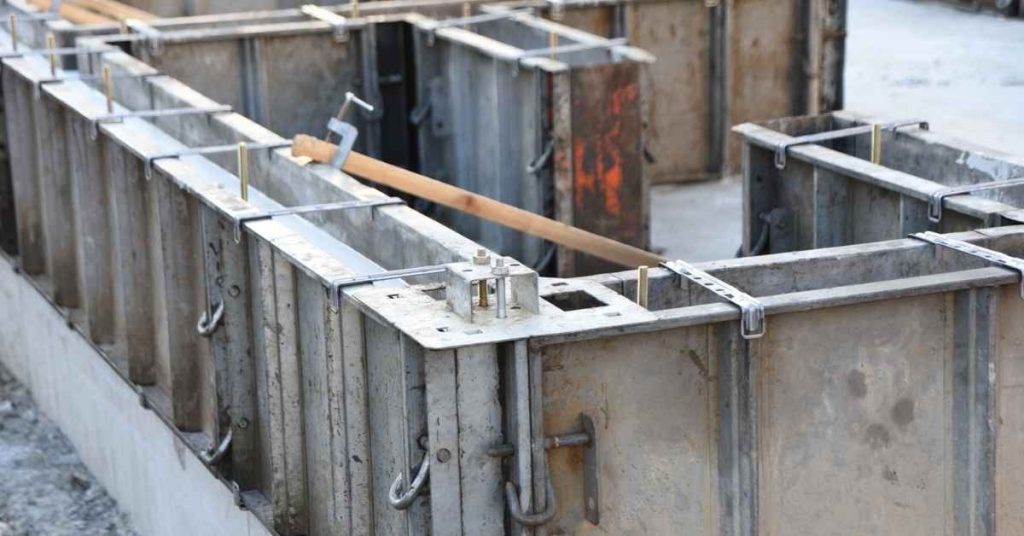
Formwork accuracy at re-entrant corners matters: ensure true geometry, avoid sharp edges unless chamfered, and verify alignment and interfaces to prevent stress risers. For reinforcement and joints, keep proper spacing, cover, and anchorage to avoid weak spots near corners during shrinkage.
Near corners, control the pace of pours, maintain uniform mix quality, and sequence placements to reduce differential settlement. Target targeted consolidation and avoid over-vibration that creates micro-cracks. Manage curing and temperature with practical measures to keep tensile stresses low early on and after form removal.
Proper Curing and Moisture Management
Curing is crucial to prevent corner cracking. Keep the concrete moist for at least seven days after placement.
Blanket or mist cure the slab, maintaining surface humidity around 95%. This slows down the hydration process, reducing early-age shrinkage and thermal gradients that can cause cracks at corners.
Use curing compounds if needed. They form a protective barrier, preventing moisture loss and helping maintain a consistent temperature.
Consolidation, Vibration, and Finishing Near Corners
Proper consolidation is key to avoid voids that can weaken corners. Use vibrators to remove air pockets, but be careful not to over-vibrate.
Around re-entrant corners, use targeted consolidation methods. Vibrate from the outside in, ensuring concrete fills all corners completely.
Finishing should also be done carefully. Avoid excessive bleed or overworking, which can cause segregation and weaken the concrete at corners.
Cold- and Hot-Weather Precautions
Temperature extremes can exacerbate corner cracking. In cold weather, keep concrete warm during placement and curing. Use insulated forms, heaters, or heating blankets.
In hot weather, protect the concrete from direct sunlight and high temperatures. Use shade cloths, wet burlap, or other protective covers. Keep the concrete moist to prevent rapid drying and early-age cracking.
Monitor both ambient and internal temperatures. Adjust curing methods as needed to maintain a consistent temperature throughout the slab.
Common Mistakes and How to Avoid Them
Omitting or misplacing joints at re-entrant corners creates uncontrolled tensile stresses. Plan for control joints, expansion joints, and proper spacing, and verify joint widths and intervals during planning. Avoid rigid, square geometries in high-stress zones by rounding or chamfering corners.
Inadequate curing and protection leads to rapid drying and early crack potential. Ensure proper moisture, curing compounds, or steam where appropriate, and protect from wind and sun. Subgrade preparation and drainage are critical to prevent settlement and shrinkage cracking at corners, so verify base conditions and moisture control as part of the plan.
Design-stage oversights
At the design stage, it’s crucial to get things right to prevent cracking at re-entrant corners. Here are some common mistakes and how to avoid them.
Missing fillets: Sharp 90-degree corners concentrate stress. Add fillets or radii to soften these corners.
Improper joint layout: Control joints and expansion joints must be planned properly. Too few, too close, or improperly spaced joints can’t relieve tensile stresses effectively. Refer back to our earlier discussion on strategic joint placement for guidance.
Inadequate reinforcement: Reinforcement helps concrete resist cracking. Ensure rebar/mesh is correctly placed and tied in. Avoid congestion that can trap cracks. Consider alternate reinforcement strategies at complex geometries.
Field execution errors
Even with a good design, mistakes during construction can lead to cracking. Here are some field errors to avoid:
- Skipping joint saw cuts: Cut control and expansion joints before concrete sets. This helps relieve stress and prevents random cracking.
- Poor compaction: Inadequate vibration leads to honeycombing, reducing strength and increasing the risk of cracking.
- Rushed curing: Concrete needs time to gain strength. Rushing curing can lead to premature drying and cracking. Follow recommended curing methods and durations.
- Ignoring subgrade prep: A clean, well-compacted subbase with proper drainage prevents settlement and shrinkage-related cracking at corners.
- Overworking concrete near corners: Excessive troweling or over-vibrating can create micro-cracks that grow into larger cracks under stress.
Timely form removal, controlled vibration, and careful finishing are key to preventing corner cracking. Plan for weather contingencies and temperature limits as well.
Cost and Lifecycle Considerations: Prevention Vs Repair
Discuss upfront investments in detailing, joints, reinforcement, and low-crack mixes versus potential repair costs and downtime later. Look for clear guidance on precision geometry, continuous reinforcement strategies, and materials that reduce shrinkage and cracking risk, noting to verify recommendations per project requirements.
When evaluating lifecycle costs, compare preventive measures against expected maintenance, including repairs and disruption. Consider climate and load exposure to judge risk and the value of preventive detailing, noting that exact figures and thresholds must be sourced from project specifications or local standards.
Upfront Detailing and Material Choices vs Repair Costs
The right layout and materials upfront can save you big bucks later. Here’s how:
- Precision in Re-entrant Corner Geometry: Use templates, measure twice to cut once. Avoid: sharp corners that concentrate stress.
- Continuous Reinforcement: Bars all the way through. Spec: #4 or #5 bars at corners. Avoid: gaps that cause cracking.
- Controlled Shrinkage Concrete: Low shrinkage mixes prevent cracks. Look for ASTM C150 Type III. Avoid: high-shrinkage concrete in large slabs.
- Sealants: Apply at joints and control joints. Spec: flexible, UV-resistant sealants. Avoid: cracking due to moisture or temperature changes.
- Fibers or External Post-Tensioning: Add fibers for extra strength. Or use post-tensioning for large slabs. Spec: ASTM C1270 for fibers. Avoid: over-reliance on one method, combine strategies.
When to Retrofit or Repair a Cracked Corner
Cracks happen. Here’s how to decide what to do:
Minor Cracks (less than 1/8 inch): Often cosmetic, can be sealed with a flexible sealant.
Moderate Cracks (1/8 to 3/4 inch): Could indicate structural issues. Consider joint retrofits or undersealing. Consult an engineer if unsure.
Severe Cracks (over 3/4 inch): Structural fix may be needed, like crack injection or stitching. Always consult an engineer for severe cracks.
Tools, Materials, Specs, and Visual Checkpoints for Inspection
Prepare a DIY-friendly toolkit and reference materials for re-entrant corner work, including layout aids and edge considerations. Look for substitute materials that homeowners can reasonably handle, while noting where pro-grade options are advisable. Reference standards and specs with plain explanations and practical checks.
Follow step-by-step layout and formwork guidance to minimize stress concentrations, including templates and proper joint placement. During pours, perform visual checkpoints for alignment, edge lines, moisture cover, and surface cues specific to re-entrant geometry, and use a simple pass/fail checklist for quick reviews.
Tools and materials checklist
Use this checklist before starting your concrete corner detailing and curing process to ensure you have everything you need for a successful job.
- Trowel (1/2″ or 3/4″): Check size; it should match the finish desired. Incorrect size can lead to improper finishing.
- Float (4′ x 8′): Ensure it’s in good condition with no missing tines. A damaged float can cause surface imperfections.
- Edging tool: Confirm it’s suitable for the corner detail you’re creating. Using the wrong tool can result in poor detailing.
- Curing compound or membrane: Check product label for coverage rate and application method. Skipping proper curing can lead to cracked or weak concrete.
- Measuring tape: Verify it’s in good working condition. An inaccurate measurement can result in improper mixing or placement of concrete.
- Concrete mix (3000-4500 psi): Confirm with supplier that the mix design meets your project’s requirements. Using a mix that’s too weak or strong can cause issues down the line.
- Reinforcement (rebar, wire mesh): Check for proper size and spacing as per local building codes. Inadequate reinforcement can lead to structural failures.
- Protective clothing and safety gear: Ensure you have appropriate boots, gloves, glasses, and hard hat. Skipping safety gear can result in serious injuries.
Quick rule: Always double-check your tools and materials before starting any task to avoid costly mistakes and rework.
Material specs and standards to consult
Before you start mixing or pouring concrete, use this checklist to ensure your materials meet the required standards. This will help prevent costly mistakes and rework.
- Concrete Mix Design: Check the mix design provided by your ready-mix supplier or verify it against local building codes (e.g., ASTM C94, ACI 211). Ensure it matches your intended use (e.g., slab on grade, footing, column).
- Cement: Confirm the cement type (e.g., Type I, II, III) and check its compliance with ASTM C150. Look for any special requirements like low heat or sulfate resistance.
- Aggregates: Verify the size and type of aggregates (fine and coarse) against your mix design. Check they meet ASTM C33 standards.
- Water: Ensure water meets ASTM C1602 standards. Check for any contaminants that could affect concrete performance.
- Admixtures: Confirm the type and dosage of admixtures (e.g., air-entraining, accelerators) with your mix design. Check they comply with ASTM C494 or other relevant standards.
- Reinforcement: Verify reinforcement sizes, types (e.g., deformed bars, welded wire fabric), and spacing against your structural drawings and local building codes (e.g., ACI 318).
- Joint Materials: Check the type of joint material (e.g., sawcut, expansion joints) and ensure they meet ASTM C961 standards. Verify their compatibility with your concrete mix.
- Concrete Testing: Ensure you have access to a certified lab or field testing equipment for slump, air content, and strength tests (ASTM C143, C231, C39).
Quick rule: Always consult local building codes and manufacturer recommendations. Never assume; always verify.
Visual checkpoints and acceptance criteria
Use this checklist before accepting work at corners to ensure quality and prevent costly rework.
- Surface Finish: Check for a smooth, uniform surface. Any rough patches or aggregates showing may indicate improper mixing or placement.
- Joint Alignment: Ensure joints are aligned and spaced correctly (typically every 10-24″ apart). Misaligned or widely spaced joints can lead to cracking.
- Visible Shrinkage Cracks: Look for hairline cracks, which may indicate excessive shrinkage. A few fine cracks are normal, but many or wide ones should be investigated.
- Curing Evidence: Verify that the concrete has been cured properly (usually by misting or covering with plastic). Improper curing can cause scaling and reduce strength.
- Corners and Edges: Check corners for proper reinforcement and formwork. Poorly formed corners may have weak spots or rough edges.
- Levelness: Ensure the concrete is level and follows the designed slope. Uneven surfaces can cause drainage issues and tripping hazards.
- Color Consistency: Confirm that the color is consistent throughout. Inconsistencies may indicate different batches or improper mixing.
- No Visible Air Pockets: Look for any signs of trapped air, which can weaken the concrete and cause pitting.
Quick rule: If in doubt, check with your local building department or the manufacturer’s instructions to ensure you’re meeting code requirements and standards.
Conclusion
Re-entrant corners crack if you rush the layout or skip details. Do the right setup now to protect safety, durability, and appearance for years to come.
Check the layout early: confirm radii or chamfers at corners, place reinforcement and joints where they actually help, verify proper form work and curing, and test a small patch to verify your method before full pours. Ensure the plan guides hardware choices and joint details, and walk through the steps in a deliberate sequence so you can catch problems before they become cracks.
Common mistakes to avoid are undersizing or misplacing reinforcement, skipping control joints, and rushing a pour with poor curing. Don’t work blind without PPE, ventilation, or a clear plan, and never skip moisture protection or proper cleaning before finishing. If you uncover existing cracks, or if the geometry is complex, or you doubt your layout, call a professional. You can finish strong and keep cracks at bay if you stay deliberate, safe, and disciplined about each step.
FAQ
What causes shrinkage cracks at re-entrant corners, and how can I spot them early?
Shrinkage cracks form as concrete dries and loses water. Look for fine, hairline cracks that extend from the inner edge of the corner; they may run across shallow sections or along joints. To limit them, control curing and keep edge forms well-sealed, and match mix and placement to the project’s conditions.
How do re-entrant corners contribute to heaving and settlement cracks, and what layout steps help?
Re-entrant corners concentrate forces as the slab tries to pull away from itself. Use gradual transitions, proper corner chamfers or rounded edges, and avoid sharp, square corners that trap stress. Ensure forms are solid and joints align with expected load paths to reduce movement concentrates.
What should I know about freeze-thaw damage at re-entrant corners, and how can layout and detailing help?
Freeze-thaw cycles push water into concrete; corners can crack first due to stress concentrations. Use adequate edge insulation and proper drainage around the slab, and keep the concrete free from water pooling near interior corners. Plan for proper slope and expansion control where temperatures swing.
What are reliable layout tricks to reduce stress at re-entrant corners in DIY projects?
Favor rounded corners or gentle angles instead of sharp re-entrant shapes. Break long, straight runs with joints or control lines that align with expected shrinkage and movement. Tie in reinforcement and ensure formwork supports proper compaction and finish at the corners.