
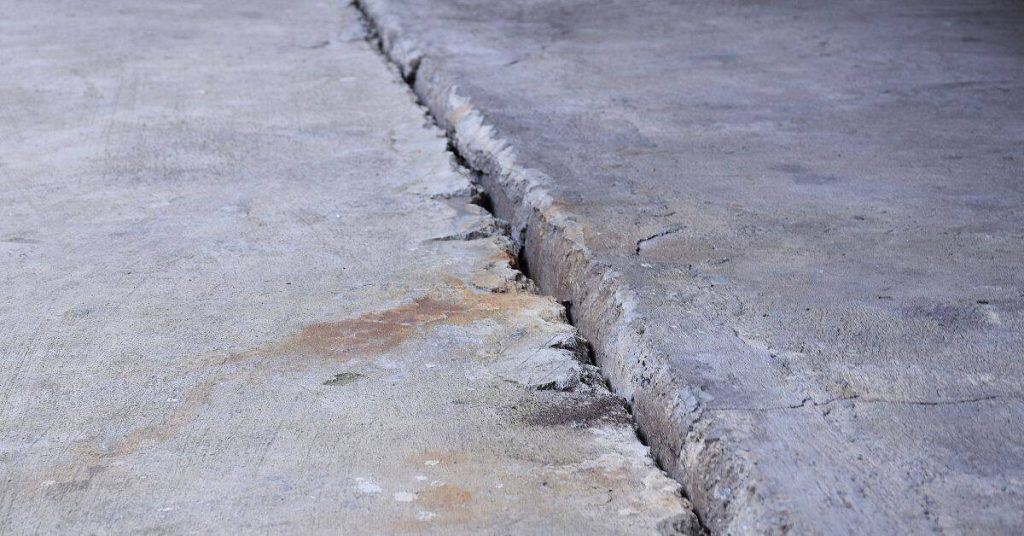
Yes. A concrete repair product can be too strong—or, more importantly, too stiff or dimensionally incompatible—for an existing slab. A hard patch is not automatically a durable patch. When bonded repair material and old concrete shrink, heat up, cool down, absorb moisture, or deflect differently, the resulting restraint can contribute to cracks, distressed edges, or loss of bond. Compare stiffness, shrinkage, moisture tolerance, repair depth, exposure, and curing requirements alongside compressive strength.
ToC
- Why the “Stronger” Patch Cracks First—or Lets Go at the Edge
- The Compatibility Properties That Matter More Than the Biggest Strength Number
- Read the Existing Slab Before You Compare Repair Bags
- Failure Patterns That Point to a Mismatch Rather Than a Weak Patch
- Do Not Proceed With a Bonded Patch If These Conditions Are Present
- Choose the Repair System Before Choosing the Strongest Bag
- Concrete Repair Compatibility Decision Tree
- Make the Handoff: When Data-Sheet Comparison Is Enough—and When It Is Not
- Frequently Asked Questions
Why the “Stronger” Patch Cracks First—or Lets Go at the Edge
A repair can look solid at first, then develop a crack around its perimeter. In another common pattern, the patch remains intact while the older concrete breaks alongside it. Sometimes the repair releases from the slab even though it initially seemed well bonded. These outcomes do not prove one single cause, but they do show why the bag with the largest compressive-strength number is not automatically the best choice.
A bonded repair and the surrounding slab work as a restrained composite system. The old concrete limits the repair’s movement, and the repair affects how the old concrete responds to loads and temperature changes. If the patch is much less willing to deform than weakened adjacent concrete, deformation demand can concentrate near the transition. If the repair shrinks as it cures while the surrounding slab restrains it, tensile stress can build in the patch, at its edges, or at the bond line.
Compressive strength describes resistance to crushing under a particular test. Compatibility is broader: it asks whether the repair can work with the existing concrete, repair geometry, moisture condition, loading, and environment over time. American Concrete Institute guidance on repair-material selection treats elastic behavior, volume change, thermal movement, creep, exposure, and substrate characteristics as related selection issues—not as details that can be replaced by a strength comparison.
That does not mean every strong repair mortar is a problem, or that a lower-strength product is safer. A suitable choice depends on the repair’s job. A deeper section repair in sound, stable concrete may require a different system from a shallow cosmetic surface defect. The key is to select a material and installation system that fit the whole condition.
The Compatibility Properties That Matter More Than the Biggest Strength Number
Elastic modulus: stiffness is not strength
Elastic modulus is a measure of stiffness: how much a material resists deformation under load. Strength and stiffness can be related in cementitious materials, but they are not interchangeable. Do not estimate modulus from advertised compressive strength if the manufacturer does not publish it. Where stiffness matters, compare reported data only when the test method, specimen age, and conditioning are reasonably comparable.
A relatively stiff repair can contribute to stress concentration where it meets more compliant, older concrete. Conversely, a lower-modulus material is not automatically appropriate; it still must meet the repair’s service, durability, thickness, and bond requirements. The ACI’s repair-material selection guidance specifically identifies modulus compatibility as a consideration that depends on the repair application and substrate.
Shrinkage, thermal movement, and creep
Drying shrinkage and other length changes matter because a bonded patch is restrained by its surroundings. A repair that wants to shorten as it dries can develop tensile stress instead. Thin and broad bonded work is especially sensitive because it has a large restrained area relative to its thickness.
Temperature adds another movement cycle. Sun on exterior flatwork, rapid weather changes, heated service areas, and shaded edges can create different temperatures in the repair and slab. Different coefficients of thermal expansion, temperature gradients, and joint restraint can all matter. Creep—time-dependent deformation—also affects how stress relaxes. Tensile behavior and crack resistance matter as well, so no single test value predicts field performance.
Bond, permeability, and moisture behavior
A published bond result is useful, but it is test-specific. It does not by itself establish durable bond through wetting, vapor movement, thermal cycling, traffic, or a different preparation condition. Interface shear caused by differential movement can be as important as initial adhesive strength.
Also check what moisture condition the product requires. A material intended for a damp or saturated-surface-dry substrate is not necessarily suitable over active water entry or water pressure. A low-permeability repair can also change how moisture moves through a repair area. Compare the complete system’s stated moisture limitations, primer or bonding method, and curing requirements to the actual site—not to a guess that the slab is “mostly dry.”
ASTM C928 evaluates packaged rapid-hardening cementitious repair materials using more than compressive strength, including properties such as length change and slant-shear bond. But compliance with a product specification does not prove that a particular material is compatible with every slab, depth, exposure, or repair purpose.
Read the Existing Slab Before You Compare Repair Bags
Compatibility starts with the existing concrete. Record what is actually present before narrowing the product category.
- Soundness: Look for delamination, weak surface concrete, deteriorated edges, corrosion-related spalling, and undermined or unsupported areas. A patch cannot make weak concrete sound.
- Movement: Separate a dormant hairline shrinkage crack from an active crack, moving joint, settlement crack, heave, curling, vibration issue, or slab-to-wall interface. A repair crossing a moving feature has a different problem than a simple spall.
- Moisture: Note rain exposure, intermittent wetting, persistent dampness, interior vapor drive, water entry, and any evidence of pressure below or behind the slab.
- Geometry: Measure depth, width, location, and perimeter shape. Confirm whether the repair can be cut back to sound concrete and whether its edges can meet the candidate system’s stated geometry. A resurfacer, localized repair mortar, and deeper section-repair material are not interchangeable.
- Exposure and loading: Consider traffic, point loads, abrasion, freeze-thaw cycling, deicing salts, heat and sunlight, and chemical exposure. These conditions may govern selection more than compressive strength.
- Aggregate and finish: Aggregate size must suit the repair depth, and the finished surface must suit its intended use. Similar-looking aggregate may help appearance, but it does not prove mechanical compatibility.
For example, a shallow driveway edge repair exposed to sun, tires, rain, and deicing chemicals should be evaluated as exterior traffic-exposed work. It should not be treated as equivalent to filling a small protected interior floor chip merely because both defects are shallow.
Failure Patterns That Point to a Mismatch Rather Than a Weak Patch
Visible distress is evidence, not a complete diagnosis. Before removing a failed repair, take photos and record the location, crack direction, timing, recent weather or wetting, traffic, and whether distress follows a joint or pre-existing crack.
- Perimeter crack or crack parallel to the patch edge: Possible contributors include restrained shrinkage, a stiff transition, stress concentration from the repair shape, or continuing movement in the slab.
- Old concrete cracking beside a hard patch: A stiff repair can transfer deformation demand into weaker adjacent concrete. Loads, joint locations, support conditions, and existing deterioration still need to be considered before assigning the cause.
- Patch stays intact but separates: Differential movement can shear an interface. Moisture condition, contamination, preparation, placement, and curing can also contribute. For a focused review of bond-failure patterns, see how to distinguish concrete patch bond failures.
- Crack recurring through a bonded overlay: A bonded layer does not erase an active crack or moving joint beneath it. It may reflect the movement path instead.
- Fine checking or early cracking in the repair: Rapid moisture loss, shrinkage restraint, heat, wind, low humidity, and unsuitable curing can all be factors.
Do Not Proceed With a Bonded Patch If These Conditions Are Present
Stop and reassess rather than selecting a stronger mortar if cracks are active, widening, offset, or associated with settlement, heave, joint movement, or an unresolved support problem. Do not bond over delaminated, deteriorated, contaminated, or corroding concrete and assume that a high-strength patch will stabilize it.
Persistent hydrostatic moisture, active water entry, or substrate conditions outside the candidate product instructions are not ordinary patch-material selection issues. Resolve or design for the water condition first. Likewise, a suspended slab, significant section loss, exposed or corroding reinforcement, a potentially load-bearing repair, or a safety-critical element requires repair design rather than DIY bag selection.
Safety note: Chipping, grinding, sawing, and drilling concrete can create respirable silica dust. Plan appropriate dust controls, respiratory protection, eye protection, hearing protection, and work practices before surface preparation.
Choose the Repair System Before Choosing the Strongest Bag
Start by selecting the repair-system category, then compare products that are specifically permitted for that category.
- Cosmetic shallow repair: Use only a product whose stated placement range, orientation, substrate condition, exterior or interior exposure, finish suitability, and curing instructions match the defect. Check shrinkage behavior and minimum thickness; shallow does not mean carefree.
- Deeper localized section repair: Establish the repair function first. Compare modulus where reported, volume stability, bond method, aggregate suitability, durability, and placement and curing requirements. This is not a substitute for structural design where the repair carries load.
- Bonded topping or resurfacing system: Broad, thin work has substantial restraint sensitivity. Check system-specific requirements for cracks and joints, moisture, exposure, environmental conditions, substrate preparation, and curing.
- Cracked or moving slab: Do not use compressive strength as a cure for movement. Determine the crack or joint function and underlying cause before choosing a movement-accommodating, non-bonded, or redesigned solution.
Read the current technical data sheet rather than relying on front-label claims. Look for permitted orientation and placement depth; compressive strength; elastic modulus if published; shrinkage or length-change method; bond test and conditioning; thermal or exposure information; substrate moisture limits; mixing-water limits; primer or bonding method; temperature limits; curing and protection requirements. Compare like with like: a strength result at one age and curing condition is not directly comparable with a different test condition.
Polymer-modified mortar is not automatically flexible, waterproof, low-modulus, or appropriate for every repair. Its properties and limits vary by formulation. For thin work, the relevant question is whether the particular system is approved for the depth, substrate, exposure, and curing window involved; see also thin-layer patching limits and curing considerations.
Concrete Repair Compatibility Decision Tree
Use this sequence before buying a repair material. A “no” answer does not always mean replacement is required; it means a conventional bonded patch should not be selected on compressive strength alone.
- Record location and defect. Is this horizontal flatwork, a vertical face, overhead concrete, an edge, stair, driveway, interior floor, or exterior slab? Identify the defect: spall, popout, scaling, void, crack, delamination, or section loss.
- Check for movement. Is there an active or recurring crack, joint movement, offset, settlement, heave, vibration issue, or repeated